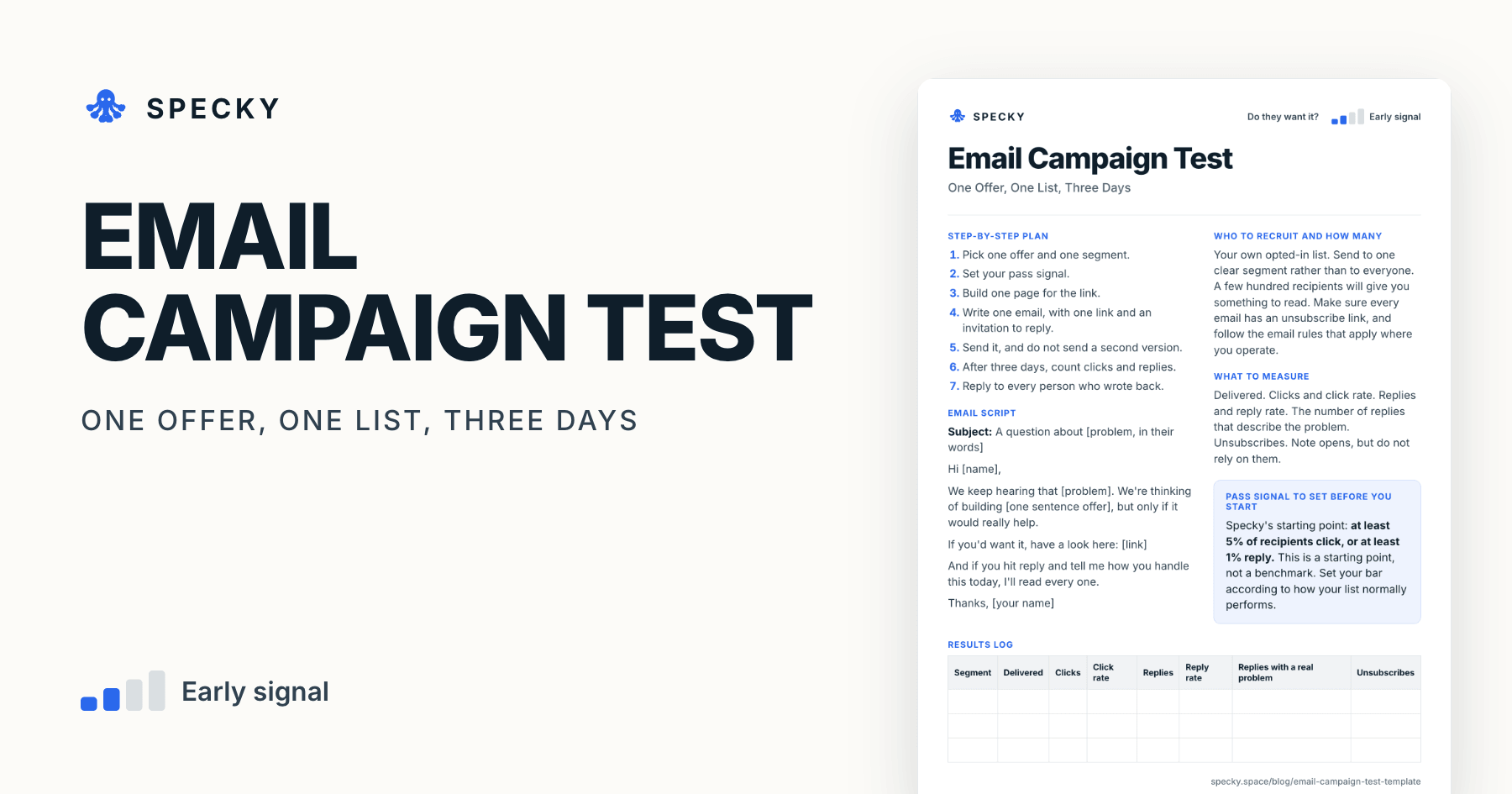
Email Campaign Test Template: One Offer, One List, Three Days
If people already chose to hear from you, you can test a new offer in three days. Count clicks and replies, ignore opens, and treat every reply as a conversation.
Share
An email campaign test sends one clear offer, with one link and an invitation to reply, to a segment of people who already chose to hear from you. After three days you count clicks and replies separately, and ignore opens. It shows within days whether a new offer earns a response from people who know you.
Key takeaways
The email campaign is one of the "interest discovery" experiments in David J. Bland and Alexander Osterwalder's Testing Business Ideas (Wiley, 2019), a library of 43 experiment types sorted by cost, time and strength of evidence (Strategyzer).
Average newsletter click rates sit between about 2% and 3%: 2.62% in Mailchimp's data as of December 2023, and a 2.09% median in MailerLite's 3.6 million campaigns from December 2024 to November 2025.
Open rates no longer tell you much: since 2021, Apple's Mail Privacy Protection hides when an email is opened.
Specky's starting pass signal is at least 5% of recipients click, or at least 1% reply. It is deliberately above the average, because you send one ask to an engaged segment.
What is an email campaign test?
It is a demand experiment that uses your own opted-in list as the audience: one offer that does not fully exist yet, one page, and a request to reply.
The method comes from the experiment library in Testing Business Ideas. A Universitat Politècnica de València (UPV) course built on the book lists the email campaign under "interest discovery", next to the online ad, link tracking, the social media campaign and the referral program. Its checklist for the email is short: a well-written topic, focused content and a specific call to action (UPV course slides).
Which risk does it test, and how strong is the evidence?
This tests : among people who know you, does this offer earn a response? The evidence is . It is real behaviour from a friendly crowd, so the result will not transfer fully to a cold audience. Our shows what to run next.
When should you run an email campaign test, and when not?
Use it when you already have a list of people who chose to hear from you, and you want a fast read on a new offer or a new direction. Replies are the prize. Someone who writes back is giving you a conversation.
Do not use it when:
You have no permission to email these people. Never buy a list. In the EU, marketing email needs prior consent (see the consent section below).
It would be your only evidence. Your list already likes you. Strangers on an online ad will be harsher.
You plan to judge by open rate. Open rates are unreliable now that some mail apps load messages automatically.
Your list is tiny. Under about 300 recipients, a 1% reply bar means two or three replies, which is too few to read.
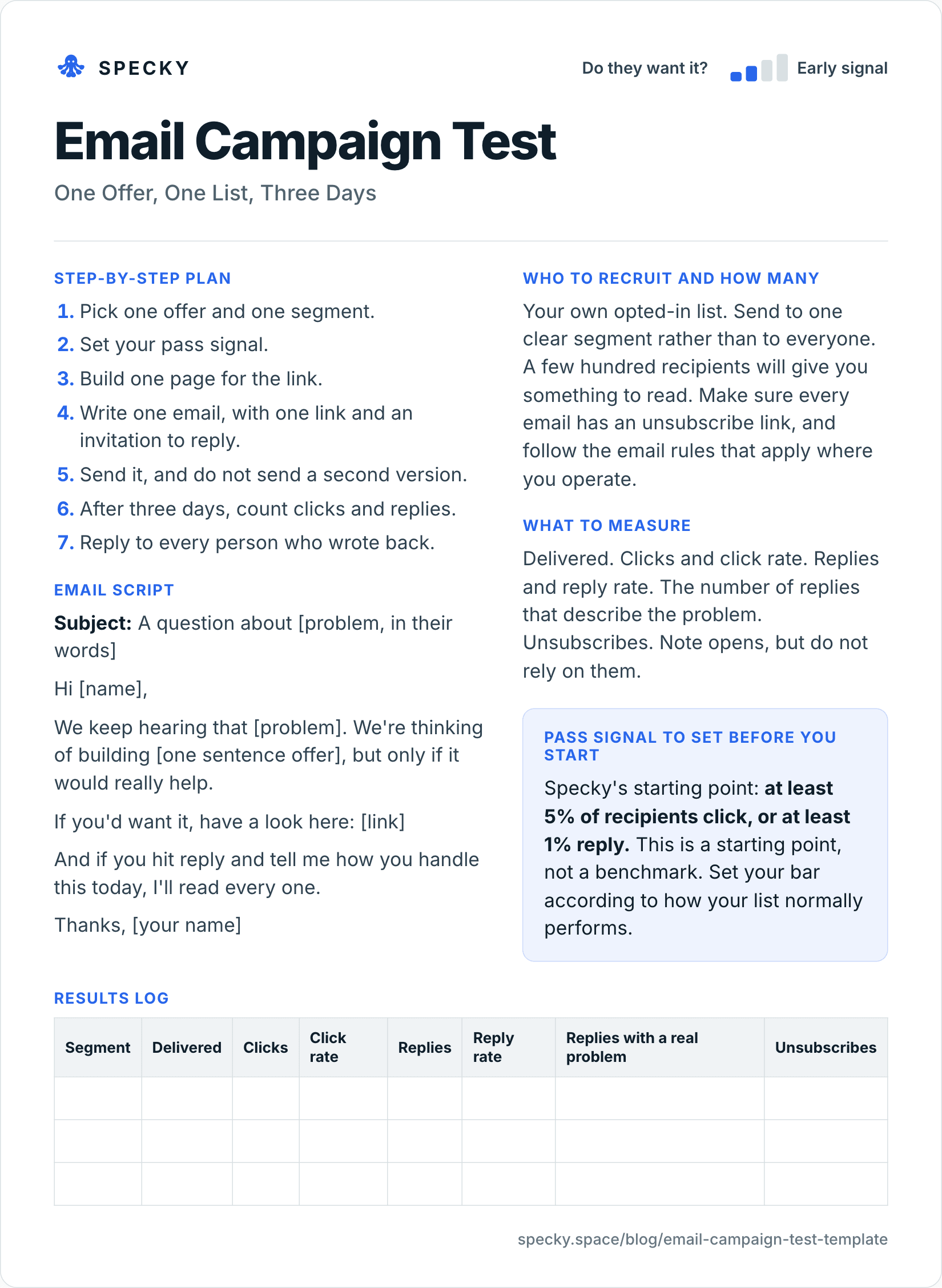
Copy-and-use email campaign test template
Open the image at full size, or copy the text version below.
Who to recruit and how many
Your own opted-in list. Send to one clear segment rather than to everyone. A few hundred recipients will give you something to read. Make sure every email has an unsubscribe link, and follow the email rules that apply where you operate.
Step-by-step plan
Pick one offer and one segment.
Set your pass signal.
Build one page for the link.
Write one email, with one link and an invitation to reply.
Send it, and do not send a second version.
After three days, count clicks and replies.
Reply to every person who wrote back.
Tag the link with utm_source, utm_medium=email and utm_campaign, the three parameters Google Analytics says to always use. Keep the values lowercase, because they are case sensitive (Google Analytics Help).
Email script
Subject: A question about [problem, in their words]
Hi [name],
We keep hearing that [problem]. We're thinking of building [one sentence offer], but only if it would really help.
If you'd want it, have a look here: [link]
And if you hit reply and tell me how you handle this today, I'll read every one.
Thanks,
[your name]
The last line does the most work. It asks what people do now, not whether they like your idea, so the answers are harder to fake. Rob Fitzpatrick's The Mom Test is built around the same aim: avoiding biased feedback, and writing emails that get people to talk (The Mom Test).
What to measure
Delivered. Clicks and click rate. Replies and reply rate. The number of replies that describe the problem. Unsubscribes. Note opens, but do not rely on them.
Pass signal to set before you start
Specky's starting point: at least 5% of recipients click, or at least 1% reply. This is a starting point, not a benchmark. Set your bar according to how your list normally performs.
Results log
Segment
Delivered
Clicks
Click rate
Replies
Reply rate
Replies with a real problem
Unsubscribes
What click rate should you expect from an email campaign test?
Expect an ordinary newsletter link to be clicked by roughly 2% to 3% of recipients. Two large published datasets agree:
Dataset
Period
Open rate
Click rate
Unsubscribe rate
Mailchimp, all users
Data as of December 2023
35.63%
2.62%
0.22%
MailerLite, all industries (median)
Dec 2024 to Nov 2025
43.46%
2.09%
0.22%
MailerLite, software and web app (median)
Dec 2024 to Nov 2025
39.31%
1.15%
0.2%
Sources: Mailchimp benchmarks, which only count campaigns sent to at least 1,000 subscribers, and MailerLite benchmarks, based on 3.6 million campaigns from 181,000 accounts. MailerLite also reports a median click-to-open rate of 6.81%.
Three things follow:
The 5% click bar is about twice the average, on purpose. A test email has one link, one ask and an engaged segment, so it should beat a newsletter with ten links. If your sends usually get 1%, start from your history.
Software audiences click less. At a 1.15% median, a 3% click rate on a test may be strong.
Nobody publishes a dependable reply-rate benchmark for this kind of email, so the 1% reply bar is a judgement call. Track your own.
Why are email open rates unreliable?
The mail app, not the person, often does the opening. Apple's Mail Privacy Protection, announced on 7 June 2021, stops senders using invisible tracking pixels and so stops them learning when an email was opened (Apple Newsroom, 2021). MailerLite says the feature marks emails sent to Apple Mail as opened automatically, so real open rates are lower than dashboards show, and Mailchimp warns its own open-rate figures may be affected.
Record opens if your tool shows them, but never use them as the pass signal. A click needs a decision. A reply needs effort.
How many recipients do you need?
Work backwards from the number of responses you want to read. Divide that number by your pass bar.
Recipients
Clicks at the 5% bar
Replies at the 1% bar
300
15
3
600
30
6
900
45
9
1,500
75
15
To read at least ten replies at a 1% bar, you need about 1,000 delivered emails.
Worked example (hypothetical)
This example is made up to show the method. A newsletter for indie game developers has 2,400 subscribers. Its author wants to know if readers would want help finding a publisher. He emails 900 readers who have opened something in the last 60 days.
Twenty-two people click, which is 2.4%, below his 5% line. But 14 people reply, or 1.6%. Nine of those explain in detail how they have tried and failed.
The signal says "clicks or replies," so it passes. He also sees that the offer is more interesting as a conversation than as a link. His next step is a concierge test with those nine.
Reading it against the benchmarks. His 2.4% click rate sits between MailerLite's 2.09% median and Mailchimp's 2.62% average. On its own, that says the link performed like an ordinary newsletter link, not like a strong offer. The 14 replies are what carry the test: 1.6% of recipients wrote a message, and 9 of 900 (1%) described a real failed attempt.
One lesson for next time: he picked his 900 by recent opens. Given how unreliable opens are, "clicked something in the last 90 days" is a safer filter.
Email campaign test vs online ad test vs social media demand test
All three are interest discovery tests. They differ in who sees the offer and how much you control. Run the email first if you have a list: it is free, and replies explain the numbers.
Is it legal to email your list about an idea that isn't built?
Yes, if they agreed to hear from you and you are honest that it is an idea:
EU: Article 13 of the ePrivacy Directive (2002/58/EC) allows direct-marketing email only with prior consent. The exception is your own customers, for similar products, if they get a free and easy way to object when you collect the address and in every message (EUR-Lex).
US: Under CAN-SPAM, you must honour an opt-out within 10 business days, keep the opt-out working for at least 30 days after sending, and each violating email can cost up to $53,088 (FTC).
Gmail: Since 1 February 2024, all senders should keep their spam rate below 0.3%, and bulk senders of more than 5,000 messages a day to Gmail must support one-click unsubscribe (Google).
Say "we're thinking of building", as the script does, never "now available". Use replies only for this research.
Common mistakes
Treating opens as interest. Mail apps can open messages by themselves.
Several links and several asks. One email, one thing to do.
Writing like a brand. A plain note from a person gets replies.
Ignoring the replies. They are the most valuable thing this test produces.
Forgetting consent. Email only people who agreed to hear from you.
Sending a second version too soon. A follow-up after day one mixes two emails into one result.
How to run it in Specky
On the Assumptions page, click the note and choose Pick a test, then Email campaign. Specky fills in the steps, the pass signal, and a three-day timeline.
Click Test with a page. Specky builds the waitlist page your email points to, and collects the responses.
Sending the email is your part, using your own email tool. Specky does not send this campaign for you.
Click Start running. Paste in delivered, clicks, and replies from your email tool, and record the result.
A pass shows as Early signal on the board, not Supported, because a friendly list is directional.
What to do with each outcome
Supported (shows as Early signal): Talk to the people who replied using a customer interview template, then try the offer on strangers with an online ad.
Unclear: Few clicks but thoughtful replies, or the reverse. Read the replies to see if the offer or the wording is the problem.
Contradicted: Your own list does not respond. That is a strong warning, because these people like you. Rework the offer. Any bet resting on this note now shows as Contradicted.
Frequently asked questions
How do you validate a product idea with email?
Send one clear offer with one link to a segment of your opted-in list, then track clicks and replies for three days. Replies are the most useful result, because each one can become a conversation. Set the pass bar before sending, such as 5% clicks or 1% replies, and treat a pass as an early signal.
How do you test how an email campaign resonates?
Measure what people do, not what their mail app does. Count clicks on the single link, replies, and replies that describe the problem in their own words. Compare the click rate with your past sends and with published averages of roughly 2% to 3%, and read every reply before deciding.
Are email open rates reliable?
No. Since Apple introduced Mail Privacy Protection in 2021, many emails register as opened without anyone reading them, and both Mailchimp and MailerLite warn that this inflates open rates. Use opens only to spot delivery problems. Judge the offer on clicks and replies, which need a real decision.
What is a good click rate for an email campaign test?
Mailchimp's all-user average is 2.62% (data as of December 2023) and MailerLite's 2025 median is 2.09%. Specky's starting bar of 5% is higher on purpose, because a test email has one link and goes to an engaged segment. Software audiences click less (1.15% in MailerLite's data), so adjust.
Is my email list a fair test of demand?
No. Your list already knows and likes you, so it responds more kindly than a cold audience would. Treat a good result as an early signal, then repeat the offer with strangers through an online ad or a landing page. A bad result from your own list tells you more: if friends do not respond, strangers rarely will.