Crowdfunding Test Template: Validate Demand With Real Pledges
Few signals are stronger than money pledged before a product exists. Few promises are bigger, either. Set the goal from real costs and know what you owe backers.
Share
A crowdfunding test publishes your offer on a platform such as Kickstarter with a funding goal and a deadline, and asks people to pledge money before the product exists. Reaching the goal is commitment evidence: strangers and fans put real money down. It also creates a real promise, so set the goal from what delivery actually costs.
Key takeaways
On Kickstarter, 42.74% of 686,810 launched projects reached their goal. Technology projects succeeded only 24.93% of the time, against 44.63% for Design and 52.32% for Games (Kickstarter stats, archived January 2026).
Campaigns rarely just miss. About 81% of failed projects raised 20% of their goal or less, while 79% of projects that passed 20% were funded. Your first days decide the result.
Most successes are small: about 65% of funded Kickstarter projects raised under $10,000.
Kickstarter takes 5% plus roughly 3-5% for payment processing, and nothing if you miss the goal (Kickstarter, 2026). Build fees into the goal.
Funding is not delivery. In Ethan Mollick's 2015 study of 30,323 Kickstarter campaigns, 8.6% of funded projects failed to deliver (CNBC, 2015).
What is a crowdfunding test?
A crowdfunding test turns a launch campaign into an experiment: you publish the offer, set a goal and a deadline, and treat reaching the goal as the pass signal. On Kickstarter's all-or-nothing model, backers are charged only if the project reaches its goal (Kickstarter, 2026), so a funded campaign means people really paid.
In David J. Bland and Alex Osterwalder's Testing Business Ideas, crowdfunding is a "call to action" validation experiment. Strategyzer's experiment library scores it 5 out of 5 for cost, the top of the scale, and 4 out of 5 for both setup and run time (Strategyzer poster). Strategyzer's summary of the book suggests 2-4 weeks to build the campaign and 4-6 weeks to run it, and calls it best for consumer products with broad appeal (Strategyzer, 2025).
Which risk does it test, and how strong is the evidence?
This tests viability: will people put money down before it exists? The evidence is commitment, at the top of the ladder in our guide to choosing a product experiment. Remember that backers tend to be early adopters. They do not always represent the wider market.
When should you run a crowdfunding test?
Use it for consumer products, especially physical ones, where people enjoy backing something new and where the money helps pay for the first production run. Few tests are as direct. Pebble Time, for example, passed $13.3 million in March 2015 and became Kickstarter's most-funded project at the time, after an earlier Pebble campaign.
Do not use it unless you could really deliver. A campaign is a promise to real people, and failing them has consequences for them and for you. Avoid it for business software with a small number of buyers, where a letter of intent fits much better. And plan the audience first. Campaigns tend to fail without an existing group of people ready to back them on day one.
Run cheaper tests first. A crowdfunding test sits at the top of the library's cost scale, so arrive with evidence that people want the thing: a presale interest page for the price, a 3D-printed prototype for the object, and an explainer video test for the story your campaign video will tell.
Copy-and-use crowdfunding test template
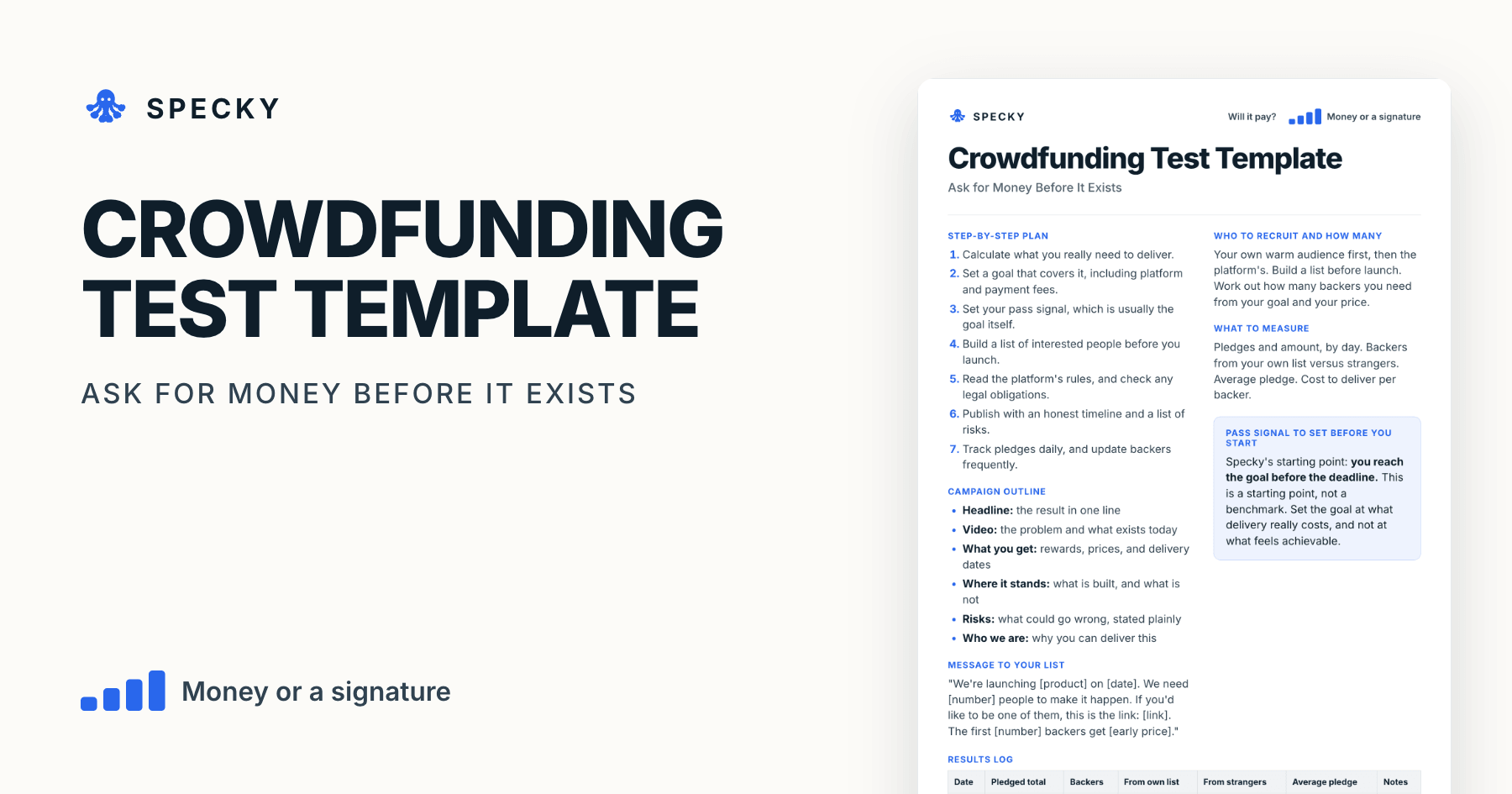
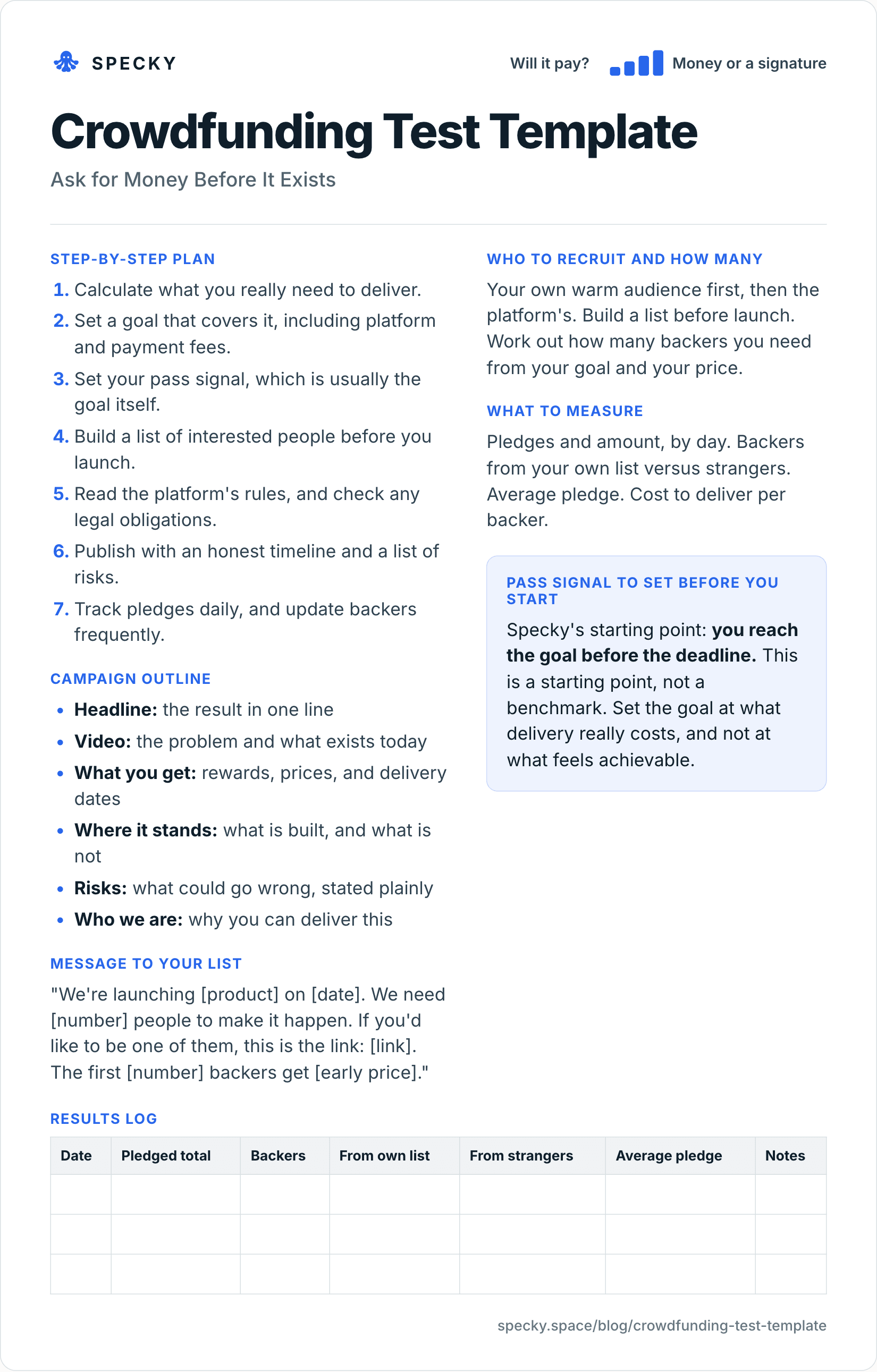
Open the image at full size, or copy the text version below.
Who to recruit and how many
Your own warm audience first, then the platform's. Build a list before launch. Work out how many backers you need from your goal and your price.
Step-by-step plan
Calculate what you really need to deliver.
Set a goal that covers it, including platform and payment fees.
Set your pass signal, which is usually the goal itself.
Build a list of interested people before you launch.
Read the platform's rules, and check any legal obligations.
Publish with an honest timeline and a list of risks.
Track pledges daily, and update backers frequently.
Campaign outline
Headline: the result in one line
Video: the problem and what exists today
What you get: rewards, prices, and delivery dates
Where it stands: what is built, and what is not
Risks: what could go wrong, stated plainly
Who we are: why you can deliver this
Message to your list
"We're launching [product] on [date]. We need [number] people to make it happen. If you'd like to be one of them, this is the link: [link]. The first [number] backers get [early price]."
What to measure
Pledges and amount, by day. Backers from your own list versus strangers. Average pledge. Cost to deliver per backer.
Pass signal to set before you start
Specky's starting point: you reach the goal before the deadline. This is a starting point, not a benchmark. Set the goal at what delivery really costs, and not at what feels achievable.
Results log
Date
Pledged total
Backers
From own list
From strangers
Average pledge
Notes
What is the Kickstarter success rate?
Across all categories, 42.74% of finished Kickstarter projects reached their goal. The rate varies widely by category, and so does the size of a typical success. The figures below come from Kickstarter's own stats page, last updated 17 January 2026; the live page now redirects to Kickstarter's 2025 review, which calls 2025 its biggest year to date (Kickstarter, 2025).
Hardware is hard. Technology fails three times in four, and the projects that do succeed tend to be large; 22% of funded technology projects raised $100,000 or more.
Failures fail early. Of 391,957 unsuccessful projects, 60,587 raised nothing and 255,623 raised between 1% and 20%. Only 7,644, about 2%, reached 81-99%. Kickstarter's own summary: 9% of projects never received a single pledge, while 79% of projects that raised more than 20% of their goal were funded.
Your list decides the start. If early pledges come from people who already know you, plan the first 20% of the goal from your own list before launch.
How do you set a crowdfunding goal?
Work backwards from delivery, not forwards from hope.
Add up what delivery costs: tooling, the first production run, packaging, shipping, and a buffer for things that go wrong.
Gross it up for fees: goal = delivery cost ÷ (1 − fee rate). On Kickstarter, the 5% platform fee plus roughly 3-5% processing means a fee rate of about 8-10% (Kickstarter, 2024).
Turn it into backers: backers needed = goal ÷ average pledge.
Check your list: compare backers needed with the people you can reach on day one.
Overfunding is not free money. Every extra backer is another unit to make and ship, so check that your cost per unit still holds above the goal.
Worked example (hypothetical)
This example is made up to show the method. A two-person team has designed a modular plant shelf. Tooling and a first run of 300 units cost €42,000. Adding fees, they set a goal of €48,000, with shelves at €160.
They build a list of 1,100 people before launching. In 30 days they raise €53,000 from 331 backers. But only 90 backers came from outside their own list.
The goal was met, so the test passes. The team also notes how few strangers found it. Their own list drove this, and that limits what they can say about a larger market.
Checking the goal. At a 10% fee rate, €42,000 ÷ 0.9 is about €46,700, so €48,000 leaves a thin buffer: after fees, the goal would net about €43,200. The goal needs 300 backers at €160, which matches the 300-unit run.
Reading the result. The campaign netted about €47,700 after 10% fees. But 331 backers means 31 more shelves than the run they priced, so they check the cost of those extra units before celebrating. On the audience side, 241 of their 1,100 list members backed it (22%), and strangers made up 27% of backers. That 90 is the number to grow before calling this a market.
Crowdfunding test vs presale vs letter of intent
They differ in who commits, how, and what you owe them.
Choose crowdfunding when the money funds the first run and the campaign itself builds an audience. Choose a letter of intent when a handful of business buyers decide.
What do you owe backers if things go wrong?
A pledge is not a shop purchase, but it is a promise you must keep.
All-or-nothing vs flexible. On Kickstarter, nobody is charged if you miss the goal, and no fees are collected. On Indiegogo's flexible funding, you keep the money even if you miss the goal, and you must still fulfil the perks; fixed funding refunds backers instead (Indiegogo). Flexible funding can leave you owing products you can't afford to make.
Regulators act on broken promises. In 2015, the US Federal Trade Commission brought its case against a creator who raised more than $122,000 from 1,246 backers for a board game, delivered neither the game nor refunds, and spent most of the money on unrelated personal expenses. The settlement included a $111,793.71 judgment, suspended (FTC, 2015).
Failed delivery happens. In Mollick's study, 8.6% of funded projects failed to deliver. Film, food and technology projects were most likely to fail, and projects under $1,000 more likely than those raising $10,000-$50,000.
Pre-orders after the campaign are ordinary sales. In the US, the FTC's mail-order rule expects a reasonable basis for any shipping time you state, or 30 days if you state none, and a cancel-and-refund option when you're late (FTC). In the EU, traders should deliver within 30 days unless another time was agreed (Your Europe).
This is general information, not legal advice. Read your platform's rules and check the law where your backers live.
Common mistakes
Setting the goal too low. Reaching a goal that does not cover delivery is the worst outcome.
Launching with no audience. Campaigns seldom take off without early backers.
Hiding the risks. Backers are not buying from a shop, and they should know that.
Forgetting fees and shipping. Those can eat the margin.
Reading your list as the market. Separate friends from strangers.
Choosing flexible funding to be safe. It can leave you holding money that won't cover what you promised.
How to run it in Specky
On the Assumptions page, click the note and choose Pick a test, then Crowdfunding. Specky fills in the steps, the pass signal, and a four-week timeline.
You run this one. Specky keeps the plan and the result. The campaign runs on a crowdfunding platform of your choice, and Specky does not collect pledges.
Click Start running. Paste in the final total, backers, and source split.
Record the result.
A pass shows on the board as Supported, and moves toward the strongest evidence level, because a pledge is commitment.
What to do with each outcome
Supported: People put money down. Now deliver. Use a funnel test to see what a customer costs outside your own list.
Unclear: You got close. Look at the split between your own list and strangers, then decide if you need a bigger audience or a better offer.
Contradicted: The campaign missed its goal. On an all-or-nothing platform nobody is charged, so the cost is mainly your time. Read the comments and talk to those who did back you. Any bet resting on this note now shows as Contradicted.
Frequently asked questions
Is crowdfunding a good way to validate a product?
Crowdfunding is strong validation for consumer products, because people are putting up real money before the product exists. It is a poor fit for business software with few buyers, where a letter of intent works better. It also sits at the top of the cost scale in the Testing Business Ideas library, so run cheaper tests first.
What percentage of Kickstarter projects succeed?
About 43%. Kickstarter's stats page, last updated in January 2026, showed 42.74% of 686,810 launched projects reaching their goal. Rates differ by category: Comics 68.86%, Games 52.32%, Design 44.63%, and Technology just 24.93%. Projects that raise more than 20% of their goal usually succeed.
How do you set a crowdfunding goal?
Calculate what it truly costs to deliver, including fees and shipping, and set the goal at that number or above. Divide delivery cost by one minus the fee rate, which is about 8-10% on Kickstarter. A goal below that amount can leave you owing products you cannot afford to make.
What happens if a crowdfunding campaign misses its goal?
On all-or-nothing platforms such as Kickstarter, backers are not charged and no fees are taken if the goal is missed. On Indiegogo's flexible funding, you keep what you raised and must still deliver the perks. Check the rules of your chosen platform before you launch.
How long should a crowdfunding test run?
Strategyzer's summary of Testing Business Ideas suggests a 4-6 week campaign after 2-4 weeks of setup; Specky's plan uses four weeks. Because most failed campaigns never pass 20% of their goal, launch with your list ready to back on day one.