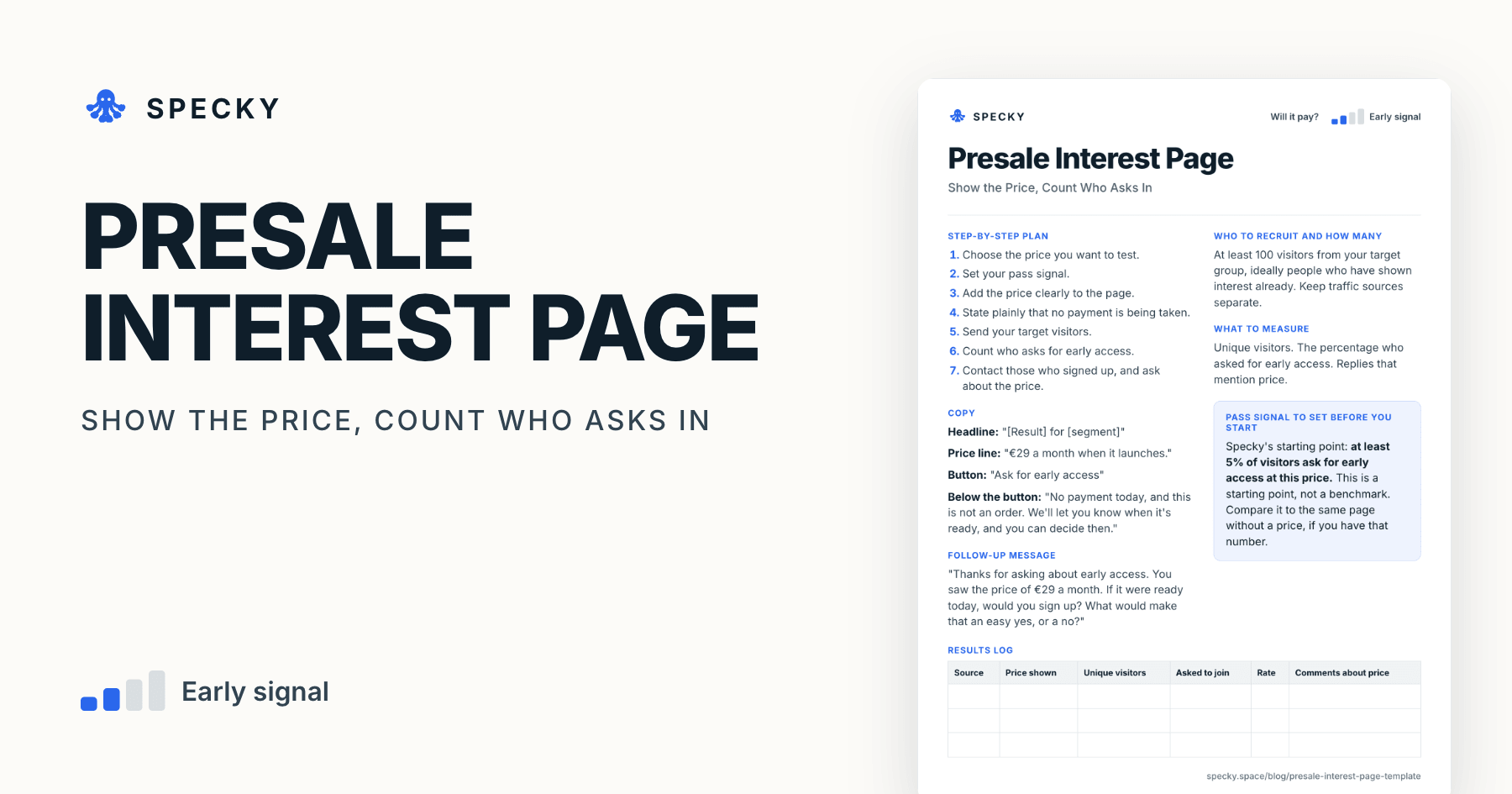
Presale Interest Page Template: Test a Price Without Taking Orders
Interest is easy when the price is hidden. Put the number on the page, say plainly that no payment is taken, and count who still asks to join.
Share
A presale interest page is an early-access page that shows the real price and counts how many visitors still ask to join, without taking an order or a payment. It answers one question: does interest survive once people see a number? It is not a sale, and a signup on it should never be logged as one.
Key takeaways
It tests viability, and the evidence is directional: a free signup made with the price in view.
In Strategyzer's experiment library for Testing Business Ideas, a real presale, where money changes hands, scores 5 out of 5 for evidence strength, a mock sale 3 and a simple landing page 2 (Strategyzer poster). A page with no checkout sits near the landing page.
Unbounce's 2024 benchmark puts the median landing page at 6.6% conversion (Unbounce, 2024). Specky's starting pass signal with a price on the page is 5%.
Small samples mislead. At 180 visitors, the gap between a 3.3% fail and a 5% pass is three people.
What is a presale interest page?
The name borrows from two experiments in David J. Bland and Alex Osterwalder's Testing Business Ideas. The book's library lists the presale among "call to action" validation experiments, next to crowdfunding and the simple landing page, and the mock sale among "simulation" experiments (UPV course slides). In a true presale, people pay before the product ships. Specky's version keeps the price and drops the payment. That is why it is called a presale interest page: without the word "interest", a count of signups starts to look like a count of sales.
Alberto Savoia described the same move in his 2011 book Pretotype It. In an invented example, an author tests a book on squirrel watching with a page that says the book isn't ready yet and invites readers to reserve a copy at "the special pre-order price of $9.98" by email. Of 23,402 people who saw her ad, 634 clicked (2.7%), and 230 of those visitors sent the email (36%) (Savoia, 2011).
Which risk does it test, and how strong is the evidence?
This tests viability: is there still interest at this price? The evidence is directional. Asking to join with a price in view says more than asking without one, but it is free to do. Our guide to choosing a product experiment explains why this name can mislead people into thinking they have a sale.
Strategyzer's summary of the book draws the same line: purchases and other actual behaviour are strong evidence, stated intentions moderate, opinions weak (Strategyzer, 2025). A free signup is a small action, not a purchase.
When should you use a presale interest page, and when not?
Use it after a plain landing page has passed, and you want to see how interest holds up once people see a number. It is a good way to find out whether a price scares your audience off.
Do not treat this as a sale. A signup is not an order, and nobody has paid or promised anything. If you want real money, run a crowdfunding test or a paid concierge test. If you want a signed commitment, ask for a letter of intent.
Skip it, too, when:
You can send fewer than about 100 visitors. The result will be mostly noise.
Price is not the doubt. If nobody wants the outcome yet, test that first with the plain page.
Your buyers never see list prices. In sales-led B2B deals, a signed letter of intent tells you more.
Copy-and-use presale interest page template
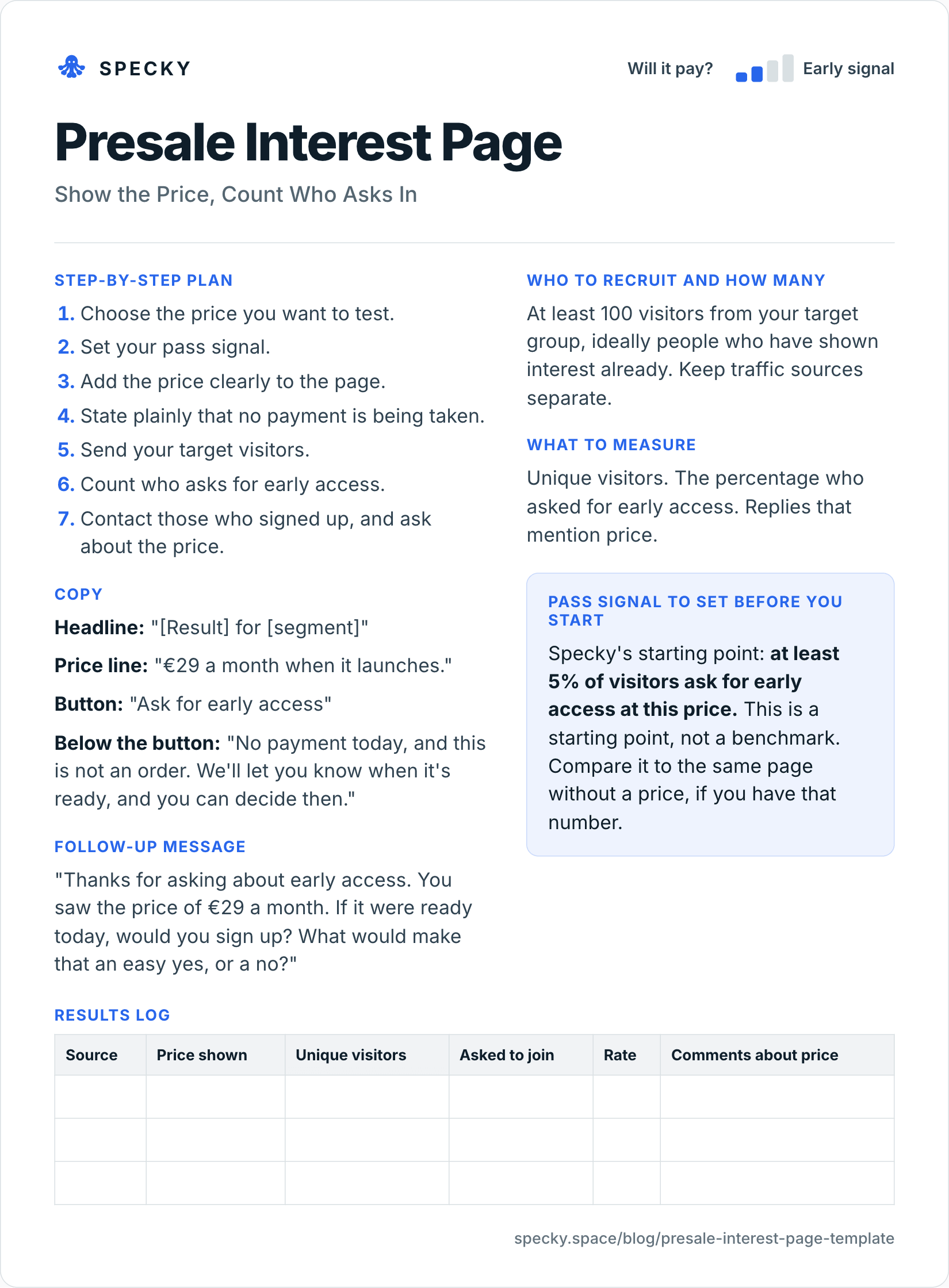
Open the image at full size, or copy the text version below.
Who to recruit and how many
At least 100 visitors from your target group, ideally people who have shown interest already. Keep traffic sources separate. Send the same sources you used for the page without a price, so the two rates can be compared.
Step-by-step plan
Choose the price you want to test.
Set your pass signal.
Add the price clearly to the page.
State plainly that no payment is being taken.
Send your target visitors.
Count who asks for early access.
Contact those who signed up, and ask about the price.
Copy
Headline: "[Result] for [segment]"
Price line: "€29 a month when it launches."
Button: "Ask for early access"
Below the button: "No payment today, and this is not an order. We'll let you know when it's ready, and you can decide then."
Follow-up message
"Thanks for asking about early access. You saw the price of €29 a month. If it were ready today, would you sign up? What would make that an easy yes, or a no?"
What to measure
Unique visitors. The percentage who asked for early access. Replies that mention price.
If you ran the same page without a price, also work out the drop the price caused: drop = 1 − (rate with price ÷ rate without price). A page that converted at 8% without a price and 4% with one lost half its interest to the number.
Pass signal to set before you start
Specky's starting point: at least 5% of visitors ask for early access at this price. This is a starting point, not a benchmark. Compare it to the same page without a price, if you have that number.
Results log
Source
Price shown
Unique visitors
Asked to join
Rate
Comments about price
What conversion rate should a presale interest page get?
Nobody publishes a benchmark for this exact test, so treat outside numbers as context, not targets.
Reference point
Rate
What it counted
Unbounce median, all industries (2024)
6.6%
Conversions on 41,000+ landing pages, most with no price shown
Savoia's book example (invented)
36%
Visitors from a targeted ad who emailed to reserve a $9.98 book
Buffer's plans page
not published
Visitors who picked a plan, then left an email
Specky's starting pass signal
5%
Visitors who ask for early access with the price shown
A warm, narrowly targeted audience and a low price can produce rates far above any benchmark, as Savoia's example shows. What matters is the drop against the same page without a price.
Buffer shows what a pass can lead to. Joel Gascoigne put a page of plans between his landing page and the email form, which showed which plan each visitor preferred. Enough people clicked through that he started building; the first version took about seven weeks, and the first paying customer arrived within four days of launch (Gascoigne, 2011).
How many visitors do you need?
At 100 visitors, a 5% pass is five people. In the worked example below, 6 signups from 180 visitors is 3.3%, but a standard 95% confidence interval around that result runs from about 1.5% to 7.1%, which includes a pass.
Comparing two versions takes far more traffic. With the usual standards (95% confidence, 80% power), telling 8% apart from 5% needs roughly 1,060 visitors per version, and 8% from 3.3% about 380. A calculator such as Evan Miller's sample size tool does the arithmetic. Few early teams get there, so treat a small test as a reason to talk to the people who signed up.
Worked example (hypothetical)
This example is made up to show the method. A team's landing page for a contract-tracking tool got 8% of visitors to sign up. They add "€49 a month when it launches" and send 180 more visitors from the same newsletter.
Signups fall to 3.3%. When the team writes to those people, several say they expected €20 or less, and two say the price is fine for a firm but not for someone working alone.
The test fails at this price. Before lowering the price, they make a note to check a separate group of firms, because the replies suggest the audience may be the issue.
Reading the numbers. Six of 180 visitors asked in, against 8% before the price: a 59% relative drop (1 − 3.3 ÷ 8). With so few visitors, that is a strong hint, not proof. The replies carry as much weight as the rate, because two people raised the solo-versus-firm split unprompted.
The next round. The team keeps €49 and the copy unchanged, and sends 150 visitors from a newsletter read by small firms. If firms ask in at 5% or more while solo workers don't, the problem was the audience, not the price. Changing one thing at a time is what lets them say which.
Presale interest page vs landing page test vs real presale
All four can use the same page. What changes is what you ask for, and so what the answer is worth.
Scores come from Strategyzer's experiment library poster. Choose the presale interest page when the price is the doubt and you are not ready to take money. Move to a crowdfunding test or a real presale only when you can deliver what you sell.
Is it legal and ethical to show a price before the product exists?
Showing the price of something that is coming is normal. Implying it is for sale today is not. Three rules keep the test honest:
Say plainly that no payment is taken and this is not an order. The line below the button does this.
Don't fake scarcity. EU consumer rules say it is unfair to claim an offer is limited in time when it is not (Your Europe).
Collect only an email, and say what you will do with it. Delete the list if the idea dies.
Kromatic's Real Startup Book draws the line for any test that stops short of a sale: "Never capture payment you could actually charge" (Kromatic).
Real pre-orders bring real duties. In the US, the FTC's Mail, Internet, or Telephone Order Merchandise Rule requires a reasonable basis for any shipping time you state, or for shipping within 30 days if you state none; if you can't ship on time, you must get the buyer's consent to the delay, or cancel and refund promptly (FTC). In the EU, a trader should deliver within 30 days unless another time was agreed, and online buyers can cancel within 14 days of delivery (Your Europe, delivery; Your Europe, returns). This is general information, not legal advice.
Common mistakes
Calling it a presale in your own notes. Then you start treating signups as revenue.
Hiding that no payment is taken. People need to know what they are agreeing to.
Changing price and audience together. You will not know which one moved the number.
Burying the price. If nobody sees it, you have not tested it.
Counting these as customers. They are people who raised a hand.
Deciding on a handful of visitors. At 100 visitors, one person moves the rate by a full percentage point.
Testing a price you would never charge. Put the number you plan to use on the real pricing page.
How to run it in Specky
On the Assumptions page, click the note and choose Pick a test, then Presale interest. Specky fills in the steps, the pass signal, and a one-week timeline.
Click Test with a page. Specky builds a waitlist page and collects responses. It does not take orders or payments.
Add your price to the copy, and check that the page says no payment is being taken. You send the traffic.
Click Start running, then compare the responses to your pass signal, and record the result.
A pass shows as Early signal on the board, not Supported, because a free signup is rated directional even with a price on the page.
What to do with each outcome
Supported (shows as Early signal): Interest survives the price. Ask for real commitment with a letter of intent or a crowdfunding test.
Contradicted: Interest collapses at this price. Check the audience before changing the number. A pricing survey will show a range. Any bet resting on this note now shows as Contradicted.
Frequently asked questions
Is a presale interest page the same as taking pre-orders?
No. A presale interest page only measures who asks for early access once they see the price. It takes no order or payment, so it should never be counted as a sale. A real presale or pre-order takes money before the product ships. That is stronger evidence, and it brings delivery and refund duties under consumer law.
Why show the price on a waitlist page?
Showing the price tests whether interest holds up at that number. A waitlist without a price tells you people like the idea for free. Comparing the two rates on the same traffic shows how many signups the price costs you, and the follow-up replies tell you why people hesitated.
What is stronger evidence than a signup with a price?
A payment, a pledge, or a signed letter of intent are all stronger, because each one asks the person to commit something. In Strategyzer's experiment library, a real presale scores 5 out of 5 for evidence strength, against 3 for a mock sale and 2 for a simple landing page.
How many visitors does a presale test need?
At least 100 per traffic source for a first read, and more if the result lands near your pass signal. At 100 visitors, a 5% signal is five people. Telling 8% apart from 5% with standard statistical confidence takes about 1,060 visitors per version, so small tests should lead to conversations, not verdicts.