Referral Program Test: Will Users Put Their Name on It?
A referral means someone put their own name on your product. Find out if they will, without building any referral software or offering a reward.
Share
A referral program test asks about 20 current users, one at a time, to bring one specific person who has the same problem, then counts the referred people who actually sign up, ignoring invitations that were merely sent. It shows whether people will put their own name on your product, before you build referral software or pay a reward.
Key takeaways
The referral program is one of seven "interest discovery" experiments in Testing Business Ideas by David J. Bland and Alex Osterwalder, rated 4 of 5 for evidence strength but 5 of 5 for run time: strong, and slow (Strategyzer experiment library).
Dropbox's founder reported that its two-sided referral program "permanently increased signups by 60%", and that in the 30 days to April 2010 users sent 2.8 million direct invites (Houston, 2010).
Referred customers can be worth more. In a study of about 10,000 customers of a German bank, referred customers were about 18% less likely to leave at any point and at least 16% more valuable (Schmitt, Skiera & Van den Bulte, 2011).
Specky's starting pass signal: at least 4 of 20 users bring someone who signs up. Count users, not signups.
What is a referral program test?
A referral program test checks whether your current users will recommend you to a named person, by asking them directly and counting completed signups, with no referral software and, at first, no reward.
In Testing Business Ideas, the referral program sits in the "interest discovery" group with the online ad, link tracking, the 404 test, the feature stub, the email campaign and the social media campaign. The library rates it 3 of 5 for cost, 2 of 5 for setup time, 5 of 5 for run time and 4 of 5 for evidence strength (Strategyzer). A university course built on the book defines a referral program as a process that rewards customers for spreading the word (UPV course slides).
This version strips the reward out on purpose. You first learn whether people recommend you for free; a reward comes later, as a way to make it easier.
Referral is also the fourth stage of Dave McClure's AARRR "pirate metrics" (acquisition, activation, retention, referral, revenue), defined as users liking the product enough to refer others (McClure, Startup Metrics for Pirates). His sample funnel, labelled "not actuals", puts referral rates at 1% to 2%, a reminder of how small this stage usually is.
Which risk does it test, and how strong is the evidence?
This tests viability: can this product grow through its customers? The evidence is commitment, the top rung in our guide to choosing a product experiment. A person who completes a referral has spent social capital. Note that the commitment belongs to the referrer, and the new signup still has to stay.
Rob Fitzpatrick's The Mom Test lists introductions to colleagues and decision makers as a "reputation" commitment, alongside time and money (summary by Yevgeniy Brikman). A referral is exactly that.
When should you run a referral program test, and when not?
Use it when you have some active users and want to know if the product is good enough to recommend, and whether word of mouth could be a real growth channel. It is one of the few tests where a customer stakes something of their own: their standing with a friend or colleague.
Do not use it:
With users who have not yet got value, since all you will measure is how much they wish to be polite.
With a big reward at first, because you will then be measuring the reward and not the recommendation.
Where users have no peers who could buy.
Before you have about 20 satisfied users. With fewer, run customer interviews.
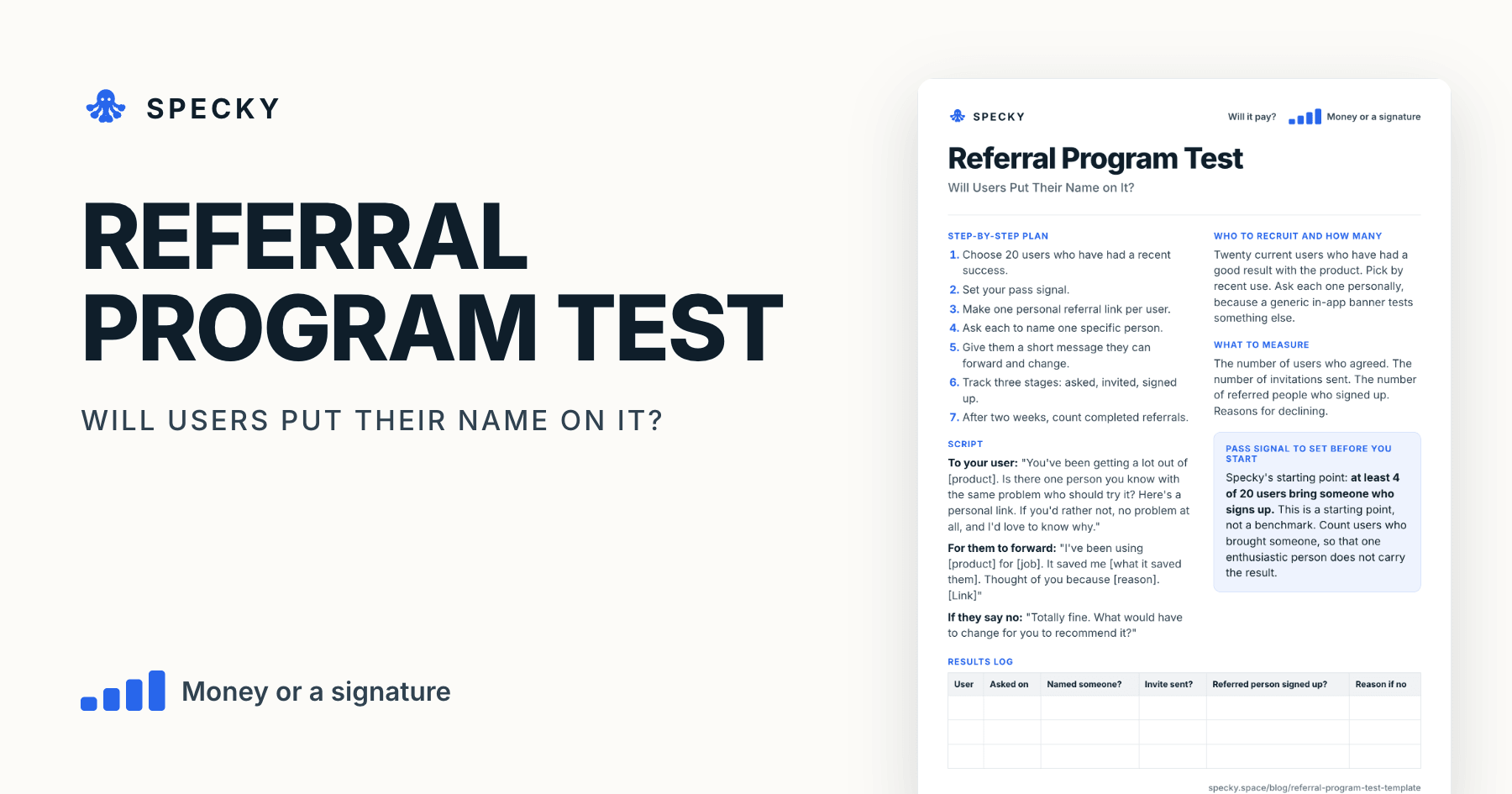
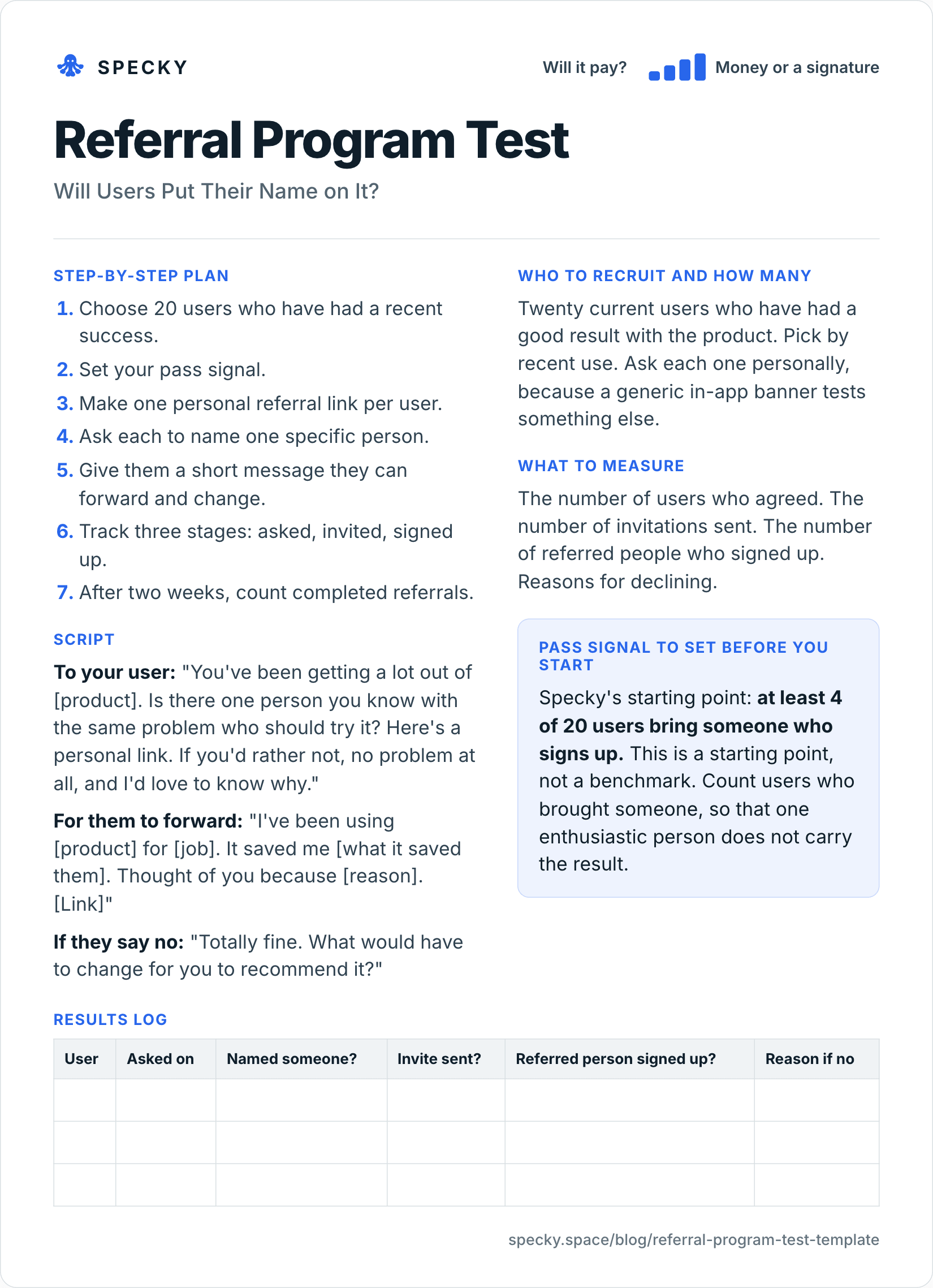
Copy-and-use referral program test template
Open the image at full size, or copy the text version below.
Who to recruit and how many
Twenty current users who have had a good result with the product. Pick by recent use, or by who answered "very disappointed" on a product-market fit survey. Ask each one personally, because a generic in-app banner tests something else.
Step-by-step plan
Choose 20 users who have had a recent success.
Set your pass signal.
Make one personal referral link per user.
Ask each to name one specific person.
Give them a short message they can forward and change.
Track three stages: asked, invited, signed up.
After two weeks, count completed referrals.
Script
To your user: "You've been getting a lot out of [product]. Is there one person you know with the same problem who should try it? Here's a personal link. If you'd rather not, no problem at all, and I'd love to know why."
For them to forward: "I've been using [product] for [job]. It saved me [what it saved them]. Thought of you because [reason]. [Link]"
If they say no: "Totally fine. What would have to change for you to recommend it?"
What to measure
The number of users who agreed. The number of invitations sent. The number of referred people who signed up. Reasons for declining.
Pass signal to set before you start
Specky's starting point: at least 4 of 20 users bring someone who signs up. This is a starting point, not a benchmark. Count users who brought someone, so that one enthusiastic person does not carry the result.
Results log
User
Asked on
Named someone?
Invite sent?
Referred person signed up?
Reason if no
What did Dropbox's referral program actually show?
Dropbox is the case everyone cites; here it is in the company's own words. Drew Houston's 2010 slides report that the program, which gave both sides a reward and was inspired by PayPal's $5 signup bonus, permanently lifted signups by 60%. In the 30 days to April 2010, users sent 2.8 million direct referral invites, and 35% of daily signups came through the program. Registered users grew from 100,000 in September 2008 to 4 million in January 2010 (Houston, 2010).
The same slides show why referral mattered: search ads cost Dropbox $233 to $388 per customer for a $99 product.
Dropbox's current terms show how the reward is built (Dropbox Help):
Dropbox referral terms
Detail
Referrer on Basic (free)
500 MB per referral, up to 16 GB
Referrer on Plus, Family or Professional
1 GB per referral, up to 32 GB
Referred friend
500 MB extra
When it counts
Only after the friend creates an account, installs and signs in to the desktop app, and verifies their email
Two lessons carry over. Dropbox counts a referral only when the friend completes setup, not when an invite is sent; this template does the same. And the reward was the product itself, extra storage, which attracts people who want the product rather than cash. But Dropbox had millions of users with a built-in reason to share files. Set your own line; do not copy its numbers.
Are referred customers worth more?
Often, yes, but check rather than assume. The best-known study tracked about 10,000 customers of a leading German bank for almost three years. The bank paid referrers a €25 voucher (Schmitt, Skiera & Van den Bulte, 2011). Compared with similar customers acquired in other ways, referred customers:
had a contribution margin about 25% higher on average, though the gap shrank over time;
were about 18% less likely to leave at any point, and that gap did not shrink;
were still customers after 33 months at a rate of 82.0%, against 79.2%;
were worth at least 16% more on average.
The gap varied by customer segment, so check rather than assume: see whether your referred people stay as long as others before you build a full program.
How many users do you need, and how long should it run?
Twenty users and two weeks. Twenty gives you a rough rate; two weeks gives busy people time to act, and referrals are slow, which is why the library rates their run time 5 of 5.
What 20 users can tell you, using a 95% Wilson interval (our calculation):
Users who brought a signup
Share
Plausible range for users like them
2 of 20
10%
about 3% to 30%
4 of 20
20%
about 8% to 42%
7 of 20
35%
about 18% to 57%
Read the drop-off between stages too. If many agree but few send, the ask is too much work. If many send but few sign up, the message or the first screen is failing the friend.
Worked example (hypothetical)
This example is made up to show the method. A meal-planning app for parents wants to know if it spreads by itself. The founders write to 20 parents who have used it each week for two months.
Eleven say they would be happy to. Seven actually send an invitation. Two referred friends sign up. In the responses of those who declined, several say the same thing: "I don't want to sound like I'm selling something."
Two of 20 is below the line of four. The test fails. People like the app, but they will not talk about it. The team drops word of mouth as a growth plan for now, and looks at channels they can buy.
Extending the example. The stages tell the story: 55% agreed, 35% sent, 10% brought a signup. The biggest loss was between agreeing and sending, and the reasons point at embarrassment rather than effort. A reward would probably make that worse, since it makes a recommendation look more like selling. So the team sets a funnel test to learn what a paying parent costs through ads, and keeps the two referred families under watch to see whether they stay.
Referral program test vs funnel test
Both ask whether you can afford to grow. One uses your users' reputations, the other your budget.
If the referral test fails, a funnel test shows whether paid channels can work. If both fail, look at the product or the segment, not the channel.
Common mistakes
Counting invites. Sending costs nothing. Only completed signups count.
Offering a big reward first. You will learn what people do for money.
Asking everybody. Only people who got value have something honest to recommend.
Not asking why people decline. The reasons are often the best part of the test.
Counting a signup as success forever. Check that the referred people stay.
Messaging the friend yourself. The user sends the invite. You have no relationship with their friend.
How do you ask for referrals without pressuring users?
Make no a comfortable answer: the script offers a way out in the first message. Three more rules:
Let the user send the invite in their own words. Do not ask for contact lists.
If you later add a reward, say so in the invite.
Never tie a user's support, pricing or access to referring someone.
How to run it in Specky
On the Assumptions page, click the note and choose Pick a test, then Referral program. Specky fills in 20 users, the pass signal, and a two-week timeline.
You run this one. Specky keeps the plan and the result. Create links and tracking with your own product or referral tool.
Click Start running. Record what you observed and paste in the counts, along with the reasons people gave for saying no.
Record the result.
A pass shows on the board as Supported, and the note moves all the way toward strong evidence, because a completed referral is rated as commitment.
What to do with each outcome
Supported: You may have a real channel. Check whether referred people stay as long as others do, with a product analytics check, before you invest in a full program.
Unclear: Many said yes, but few followed through. Make it easier to do, then try again with a small thank-you.
Contradicted: People will not recommend it. Read their reasons. This is a serious sign about the product's value, or about how embarrassing it is to mention. Any bet resting on this note now shows as Contradicted.
Frequently asked questions
How do you test a referral program before building it?
Ask about 20 happy users, one at a time, to bring one specific person using a personal link. Count how many referred people actually sign up within two weeks. You do not need referral software: a unique link per user, or a "who sent you?" field, is enough. Record why people decline, because those reasons explain the result.
Should a referral program have a reward?
Start without one. Without a reward, you learn whether people genuinely recommend the product. Add a small thank-you later if the problem is effort. Dropbox's reward was extra storage, the product itself, and the bank in the Schmitt study paid a €25 voucher. Both rewarded existing customers for bringing new ones.
Why is a referral strong evidence?
A referral is strong evidence because the person puts their own reputation at stake. Someone who brings a friend has shown more trust than someone who fills in a survey. Bland and Osterwalder's library rates it 4 of 5 for evidence strength. The commitment is the referrer's, though, so the referred person still has to stay.
What is a good referral rate for a new product?
There is no reliable benchmark for a 20-user test, so set your line in advance. Specky's starting point is 4 of 20 users bringing a signup. Dropbox's 35% of daily signups from referrals is an outlier from a product with millions of users and a built-in reason to share, and Dave McClure's sample funnel uses 1% to 2%.