AI product management
Understand the AI product manager role, choose practical tools, and keep customer evidence in the loop.
Practical guides for founders, first PMs, product engineers, and product builders: discover customer problems, decide what to build, and ship with AI.
Field guides for small teams building software, AI products, and better product habits.
Understand the AI product manager role, choose practical tools, and keep customer evidence in the loop.
Connect customer evidence, small-team workflows, and AI feature delivery from the first problem through a useful release.
Decide where AI fits, define quality and risk, and improve the feature after launch.
Practical workflows for people close to the code: learn from users, choose a small bet, and give coding agents useful context.
Turn customer signals into a focused plan, and test whether people value what your team is building.
AI-written specs sound sourced but often aren't. The Claim Trace is a 15-minute audit that labels every claim Sourced, Inferred, Assumed or Invented before engineering or a coding agent builds from it.
Practical guides, product frameworks, and Specky updates — sent when it’s worth your time.
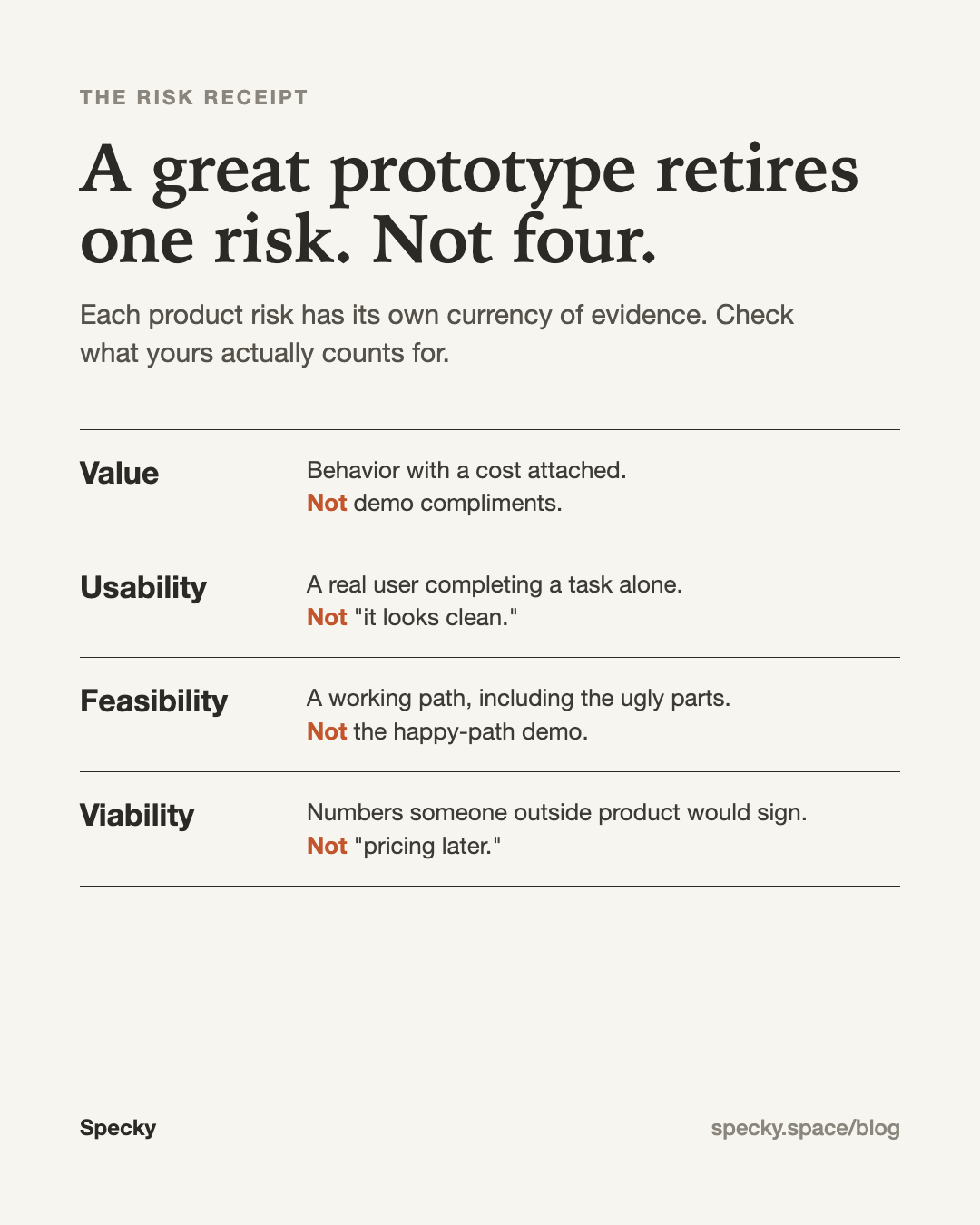
AI made feasibility cheap to prove. Value, usability and viability still need their own evidence, and a great prototype demo counts for less than it feels. The Risk Receipt shows what you've actually retired.
AI shortened the time it takes to build a feature, but not the time it takes to decide what to build or to learn whether it worked. The Three Clocks framework shows where your bottleneck moved.
Your product now has a second reader: an AI agent acting for a person. The Two-User Model and four audit questions show where your product only works because a human is watching.
PM job openings are at a near four-year high, LLM is now the top skill in PM job ads, and AI is reshaping the work. Here is every number, its source, and what it means.
A copyable weekly product manager schedule, the survey data behind it, and a two-week calendar audit to find out where your own hours really go.
A copyable checklist for EU product teams buying an AI tool in 2026, built on the official AI Act and GDPR texts, including the high-risk dates the Digital Omnibus moved to 2027 and 2028.
AI tools made building software cheaper and more common. The evidence on speed is mixed, and the cost of building the wrong thing has not moved. Here is what the 2025-2026 data actually says.
Every stakeholder now has an AI assistant and a roadmap opinion. The PM's edge is no longer more information but specific, searchable customer evidence. Here is how to map stakeholders and use it.
Find us on
GDPR-aligned. EU workspace data is stored in Frankfurt, Germany. GDPR and EU data Built in Vienna, Austria. A product of influence solutions fm GmbH (FN 675374y). Imprint 14-day trial. Card required, and nothing is charged until day 14. 30-day refund after subscribing. See pricing