Mock Purchase Intent Test: Compare Two Prices Without Selling
Compare two prices in about a week without selling anything, as long as you say plainly that no order is being placed and read every yes as a stated intent.
Share
A mock purchase intent test shows a proposed price and asks whether someone would buy, without taking an order or payment. Run it with two prices across two similar groups, one price per person, then compare the share who say yes and the rough revenue per visitor. It measures stated intent, not sales, and the page must say so.
Key takeaways
The evidence is opinion. Strategyzer's summary of Testing Business Ideas ranks stated intentions as moderate evidence, below actual behaviour such as purchases (Strategyzer, 2025).
Its closest relative in Bland and Osterwalder's library is the mock sale, scored 1 out of 5 for cost and 3 out of 5 for evidence. A real presale scores 5 for evidence (Strategyzer poster).
Compare prices on yes rate × price, not yes rate alone. The higher price wins whenever its yes rate beats the lower rate × lower price ÷ higher price.
Two groups of 200 cannot reliably tell 11% from 7%. That takes about 800 visitors per price.
Stated intent and real buying differ in both directions. Forecasting research notes that estimates taken straight from intentions are often biased, overstating or understating purchases (Armstrong, Morwitz & Kumar, 2000).
What is a mock purchase intent test?
It is an honest version of the mock sale. In Testing Business Ideas, David J. Bland and Alex Osterwalder list the mock sale among "simulation" validation experiments, alongside the Wizard of Oz and the letter of intent (UPV course slides).
The classic mock sale, also called a "dry wallet" or "covert sale", shows a real-looking listing, lets people click buy, and stops before payment with a "coming soon" or waitlist message (Kromatic). Specky's version skips the pretence. It asks the question openly ("would you buy it at this price?") and says on the page that this isn't an order. You lose some realism; you keep your visitors' trust, and your data stays honest about what it is.
Which risk does it test, and how strong is the evidence?
This tests viability: which price gets the better reaction? The evidence is opinion. Responses are stated intent, not a sale or a commitment. Our guide to choosing a product experiment shows it near the bottom of the ladder, however real the page looks.
When should you use a mock purchase intent test?
Use it when you have an audience and want to compare two prices cheaply, before you commit to one. Because the two groups see only one price each, the comparison between them is more useful than either number alone.
Do not use it as a forecast. People saying they would buy is a very different thing from buying. It should also not be set up to look like a real checkout: if someone thinks they are ordering, you have misled them. For stronger evidence, ask for a signature with a letter of intent.
It fits best when:
You have at least 200 visitors to split, ideally many more (see the sample-size section).
The two prices are far enough apart to matter, such as €19 and €39, not €19 and €21.
You already know people want the outcome. If that is still open, run a landing page test first.
Copy-and-use mock purchase intent template
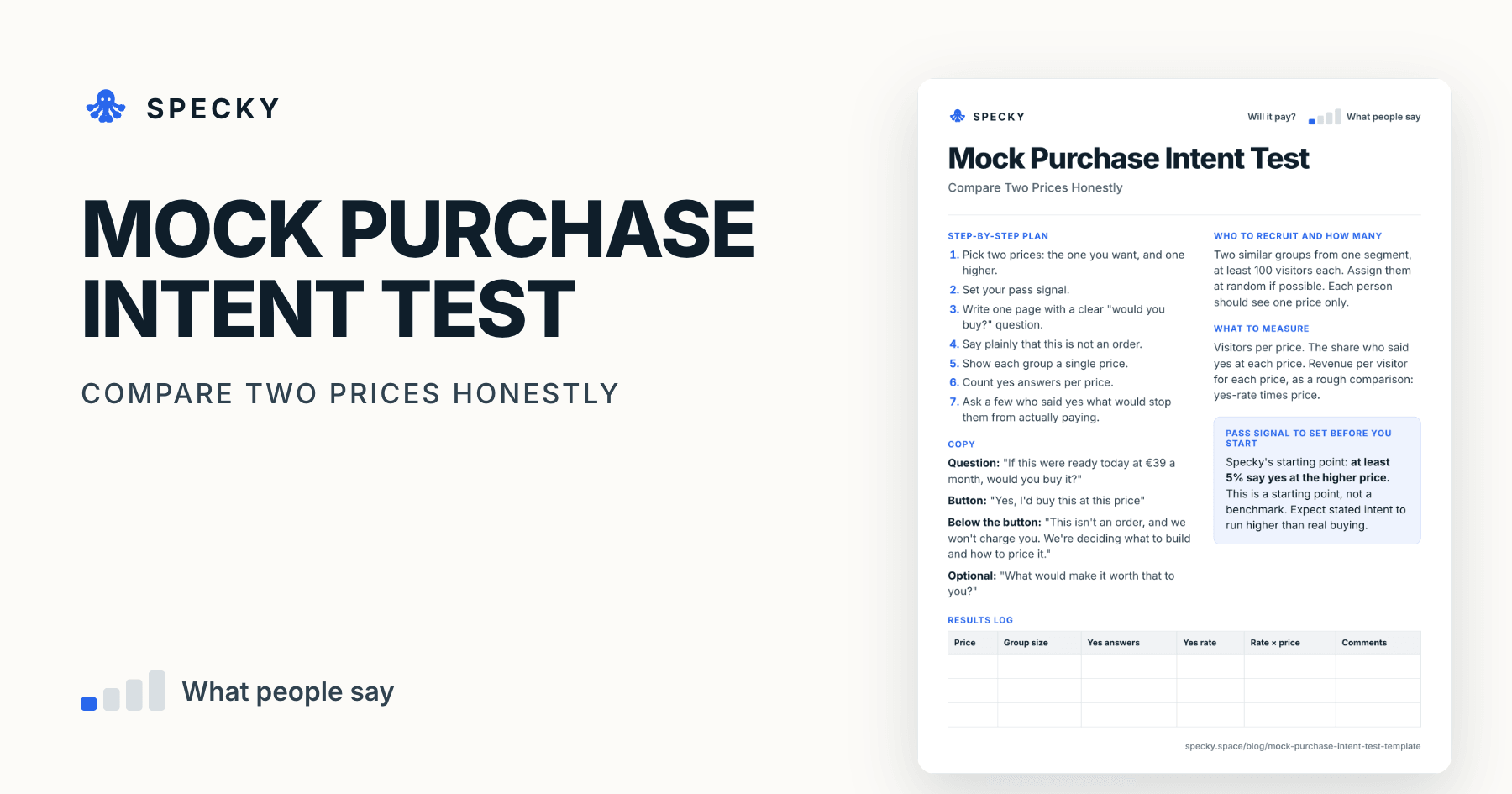
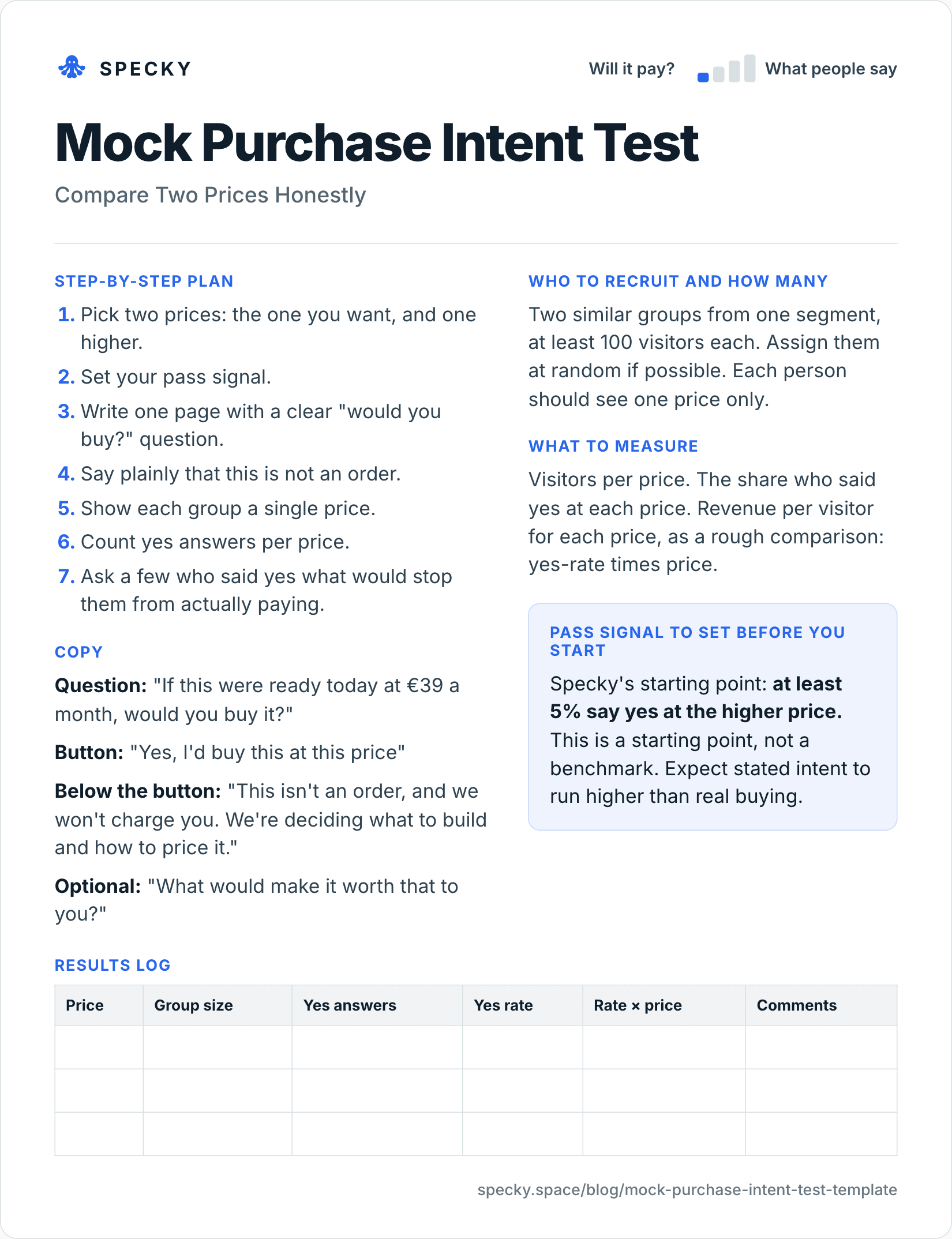
Open the image at full size, or copy the text version below.
Who to recruit and how many
Two similar groups from one segment, at least 100 visitors each. Assign them at random if possible. Each person should see one price only.
Step-by-step plan
Pick two prices: the one you want, and one higher.
Set your pass signal.
Write one page with a clear "would you buy?" question.
Say plainly that this is not an order.
Show each group a single price.
Count yes answers per price.
Ask a few who said yes what would stop them from actually paying.
Copy
Question: "If this were ready today at €39 a month, would you buy it?"
Button: "Yes, I'd buy this at this price"
Below the button: "This isn't an order, and we won't charge you. We're deciding what to build and how to price it."
Optional: "What would make it worth that to you?"
What to measure
Visitors per price. The share who said yes at each price. Revenue per visitor for each price, as a rough comparison: yes-rate times price.
Pass signal to set before you start
Specky's starting point: at least 5% say yes at the higher price. This is a starting point, not a benchmark. Expect stated intent to run higher than real buying.
Results log
Price
Group size
Yes answers
Yes rate
Rate × price
Comments
How do you compare two prices fairly?
Four rules keep the comparison clean:
One price per person. Shown both, people anchor on the cheaper one.
Random assignment, same source, same days. If €19 runs on Monday's newsletter and €39 on Friday's ad, you are testing the traffic, not the price.
Change only the number. Same headline, same copy, same button.
Decide the sample and end date first. Stopping when the numbers look good inflates false wins.
Then compare revenue per visitor, not yes rates. A cheaper price almost always wins on yes rate; the question is whether it wins by enough. The break-even yes rate for the higher price is:
Above the break-even, the higher price earns more per visitor. Kromatic's own illustration shows how steep the fall can be: 5% clicking buy at $29, falling to 1% at $49 (Kromatic). There, $29 earns $1.45 per visitor and $49 only $0.49.
How many visitors does a mock purchase intent test need?
More than most teams expect. The template's floor of 100 per price gets you a first read, not a verdict. Kromatic makes the same point: a 5% rate over 200 visitors is weaker evidence than the same rate over 2,000.
With the usual standards (95% confidence, 80% power), detecting the gap between 11% and 7% takes about 800 visitors per price, roughly 1,600 in total. Smaller gaps need more. Evan Miller's sample size calculator gives the figure for your own rates in seconds.
If you can't reach those numbers, don't fake precision. Use the test to rule out a price that collapses, and use the yes-sayers as a list of people to talk to.
How far does stated intent overstate real buying?
Nobody can give you a fixed discount, because the gap depends on the product and the question. What the research does say:
Intent predicts sales, imperfectly. Testing car purchases and wireless phone subscriptions, Armstrong, Morwitz and Kumar found intentions made sales forecasts more accurate. They also note that several studies found raw intentions give biased estimates, overstating or understating actual purchasing, so they corrected them with past sales data (Armstrong, Morwitz & Kumar, 2000).
Some buyers say no and buy anyway. The same paper cites Juster (1966): in many studies, most purchases came from people who had reported no plans to buy.
Intent works best under set conditions. Armstrong lists six, including that the respondent has a plan, can carry it out, and is the decision-maker.
For a mock purchase intent test, that means: ask the person who would pay, about a specific price, "if this were ready today". And, as Kromatic advises, treat the result as an upper bound on willingness to pay.
Worked example (hypothetical)
This example is made up to show the method. A team is deciding whether to charge €19 or €39 a month for a tool that handles customer reviews for small hotels. Half of 400 visitors see each price.
At €19, 11% say yes. At €39, 7% say yes. Multiplying rate by price, €39 gives about 2.7 per visitor, and €19 gives about 2.1, so the higher price looks better even though fewer people said yes.
The signal is met at the higher price. But the team knows this is stated intent, and they follow it up by asking a few of those who said yes to sign a letter of intent.
Checking the maths. The break-even for €39 is 5.4% (11% × 19 ÷ 39), so 7% clears it. But 7% of 200 is 14 people, and 11% is 22. A standard two-proportion test on those counts gives p ≈ 0.16: if both prices truly drew the same yes rate, a gap this large would still turn up about one time in six. To detect 11% against 7% reliably, they would need about 800 visitors per price.
What they decide. €39 becomes the working price, not the proven one. They write to all 14 people who said yes at €39 and ask them to sign a non-binding letter of intent. If four or more sign, the price has moved from opinion towards commitment.
Mock purchase intent test vs pricing survey vs presale interest page
The nearest sibling is the pricing survey: both ask about price without selling. They answer different questions.
Start with the survey when you have no idea of the range, use this test to choose between two candidates, and move to a letter of intent to turn the winner into a commitment.
Is a fake checkout ever acceptable?
No, not in this template. A page that looks like a checkout leads people to believe they are ordering, and EU consumer guidance treats both false information and leaving out important information as misleading practices; it also names deceptive design such as fake countdown timers (Your Europe). Even writers who describe the covert version flag the risk: Kromatic says never to capture payment details you could actually charge, and to make the reveal honest.
Three habits keep this test clean:
Say "this isn't an order" next to the button, not in small print.
Ask for nothing you don't need. An email for follow-up is enough; never ask for card details.
Honour the lower price. If someone who saw €19 signs up at launch, offer them €19.
Common mistakes
Making it look like a checkout. It misleads people and it makes the data worthless.
Showing both prices to everyone. The cheaper one always wins.
Reading yes answers as sales. Treat a yes rate as an upper bound on real buying.
Small groups. A difference of a few answers means nothing.
Skipping the follow-up. Ask what would stop them.
Comparing yes rates instead of revenue per visitor. The lower price nearly always wins the first and often loses the second.
How to run it in Specky
On the Assumptions page, click the note and choose Pick a test, then Mock purchase intent. Specky fills in the steps, the pass signal, and a one-week timeline.
Click Test with a page. Specky builds the page, and collects the responses. It does not take orders or payments.
To show two prices, open Experiment analytics and set up a control and a variant, with the price in the headline or subheadline. Specky assigns each visitor to one version, and compares them.
Click Start running. When you reach your numbers, record the result.
A pass shows as Early signal on the board, not Supported, because saying you would buy is opinion.
Unclear: Rates are too close. Try prices further apart, or ask for a range with a pricing survey.
Contradicted: Few people said yes, even without paying. That is a clear warning. Any bet resting on this note now shows as Contradicted.
Frequently asked questions
What is a mock purchase intent test?
A mock purchase intent test shows a price and asks whether someone would buy, without taking any payment or order. It compares reactions to different prices, one price per visitor, and is stated intent only. It is an open, honest version of the mock sale from Bland and Osterwalder's Testing Business Ideas.
Is it okay to show a fake checkout?
No. Make it clear that no order is being placed, and that nobody will be charged. A fake checkout misleads people, can fall foul of consumer rules on misleading practices, and leaves you with data you can't trust. Ask the question openly instead, and never collect card details.
How do you test two prices fairly?
Show each visitor one price at random, using similar groups from the same source over the same days. If both prices are shown to the same person, the lower price wins almost automatically. Change nothing but the number, fix the sample size in advance, and compare revenue per visitor, not yes rates alone.
How accurate is stated purchase intent?
It points in the right direction but is biased. Forecasting research finds that estimates built directly on stated intentions often overstate or understate real purchases, and need adjusting with actual sales data. Treat a yes rate as an upper bound, and confirm the winning price with a stronger test, such as a letter of intent.
What is the difference between a mock sale and a presale?
A presale takes real money before the product ships, so it is strong evidence and brings delivery and refund duties. A mock sale stops before any payment. In Strategyzer's experiment library, a presale scores 5 out of 5 for evidence strength and a mock sale 3, at a lower cost.