Lean Canvas Template: Find the Block Most Likely to Kill You
A filled-in canvas proves nothing. Here is how to sketch one in 20 minutes and make it point straight at the guess most likely to sink your idea.
Share
A Lean Canvas is a one-page business model with nine blocks, from problem to unfair advantage, that Ash Maurya adapted from the Business Model Canvas in 2010. Use this Lean Canvas template to sketch your idea in about 20 minutes, mark which blocks are guesses, and pick the one most likely to kill the idea as the first thing you test.
Key takeaways
A Lean Canvas is always one page. Maurya calls it a 1-page tool for breaking an idea into key assumptions, and recommends sketching the first version in under 20 minutes (Ash Maurya, LEANSpark, 2024).
It swaps four Business Model Canvas boxes (key partners, key activities, key resources, customer relationships) for problem, solution, key metrics and unfair advantage (Ash Maurya, LEANSpark).
LEANSTACK says the canvas is used by more than 1 million entrepreneurs (LEANSpark).
A finished canvas is still opinion. Its job is to point at the block most likely to sink you; a test has to follow.
The blocks that kill startups are real ones: 43% of shut-down startups in a 2026 CB Insights study had poor product-market fit, and 19% had unsustainable unit economics (CB Insights, 2026).
What is a Lean Canvas?
A Lean Canvas is a one-page map of nine parts of your business, from problem to unfair advantage, used to find the riskiest guess and test it.
Lean Canvas was created by Ash Maurya, who first shared it in August 2010. He built it on Alexander Osterwalder's Business Model Canvas, which comes from the book Business Model Generation, co-created by 470 practitioners from 45 countries (Strategyzer). Osterwalder had released his canvas under a Creative Commons licence that invited remixing, so Maurya kept the layout and changed four boxes to suit people starting something new.
His own definition is the most useful one: a tool that helps you deconstruct an idea into key assumptions (Ash Maurya, 2024). It is not a business plan. It is a list of guesses, arranged so you can see which one matters most.
One. The single page is the point: it forces you to write the top one to three problems, not ten, and three to five key metrics, not a dashboard. Maurya notes that the solution box is deliberately small, less than one-ninth of the canvas. If yours spills onto a second page, you are writing a plan, not a canvas.
When should you use a Lean Canvas, and when not?
Use it at the start of an idea, or when your team has different pictures of what you are building. A first version takes about 20 minutes, and it turns a vague idea into a list of specific guesses.
Do not use it as a business plan to admire. A filled-in canvas proves nothing, because every box is still your opinion. And do not linger on it. Once a block looks risky, go and test it. If you are already sure which single belief matters most, go straight to choosing a test.
It also fits poorly once you have product-market fit. LEANSTACK's own comparison recommends the Lean Canvas for new ventures and the Business Model Canvas for documenting a working business (LEANSpark comparison). If you need to set direction for an existing product, a one-page product strategy canvas is the better tool.
Which risk does it test, and how strong is the evidence?
This looks at viability across the whole business: do all the parts fit together? Marty Cagan describes business viability risk as whether a solution also works for the various aspects of your business (SVPG, 2017). The canvas also exposes desirability guesses (problem, customer segments, unique value proposition) and feasibility guesses (solution, cost structure).
The evidence is opinion, and a canvas never gets past that. Its job is to tell you what to test next. Our guide to choosing a product experiment picks up from there.
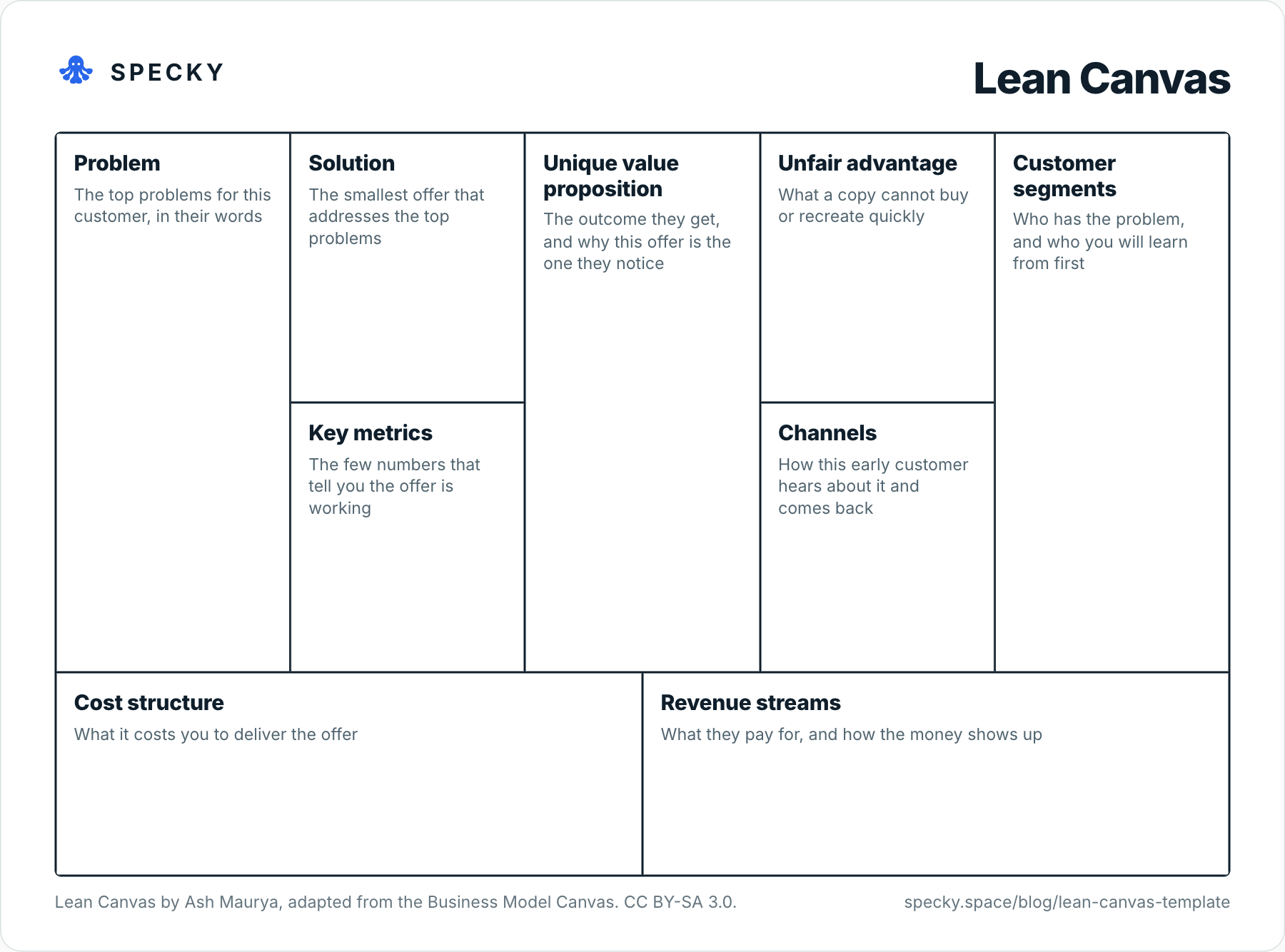
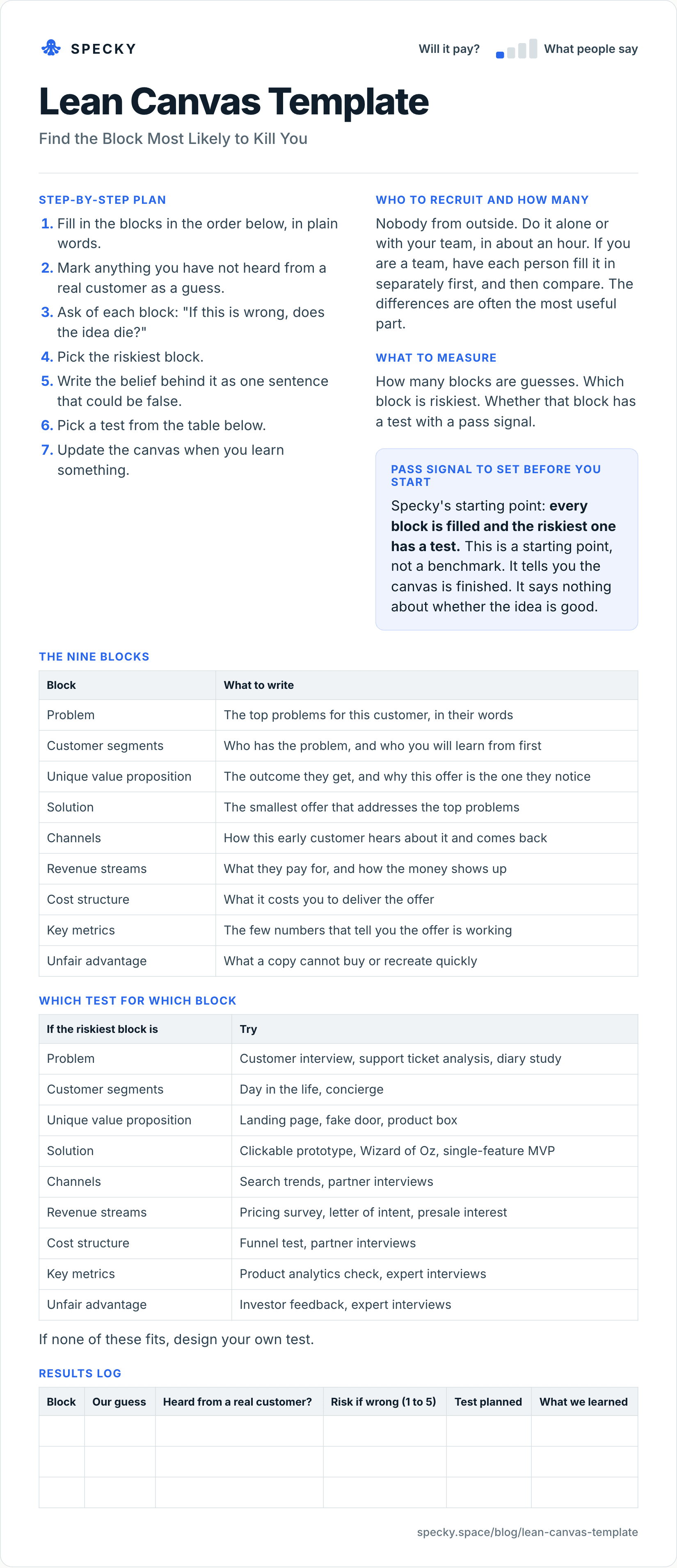
Lean Canvas template (copy and use)
Print it or redraw it, then fill in each block in plain words.
Open the image at full size, or copy the text version below.
Who to recruit and how many
Nobody from outside. Do it alone or with your team. If you are a team, have each person fill it in separately first, and then compare. Maurya gives the same advice: each team member creates their own snapshot first. The differences are often the most useful part.
Step-by-step plan
Fill in the blocks in the order below, in plain words.
Mark anything you have not heard from a real customer as a guess.
Ask of each block: "If this is wrong, does the idea die?"
Pick the riskiest block.
Write the belief behind it as one sentence that could be false.
Pick a test from the table below.
Update the canvas when you learn something.
The nine blocks
Block
What to write
Extra prompt (bold terms are sub-prompts on Maurya's current canvas)
Problem
The top problems for this customer, in their words
List the top one to three, plus the existing alternatives: how people solve it today
Customer segments
Who has the problem, and who you will learn from first
Name the early adopter, not the mainstream customer
Unique value proposition
The outcome they get, and why this offer is the one they notice
Add a high-level concept, a short pitch; it is not your landing-page headline
Solution
The smallest offer that addresses the top problems
Keep it small; it is rarely the riskiest block
Channels
How this early customer hears about it and comes back
Start with a direct route to customers
Revenue streams
What they pay for, and how the money shows up
Write a price, not "subscription"
Cost structure
What it costs you to deliver the offer
Think three to six months ahead
Key metrics
The few numbers that tell you the offer is working
Three to five numbers
Unfair advantage
What a copy cannot buy or recreate quickly
If you have none yet, write "none yet"; that is honest
How many blocks are guesses. Which block is riskiest. Whether that block has a test with a pass signal.
Pass signal to set before you start
Specky's starting point: every block is filled and the riskiest one has a test. This is a starting point, not a benchmark. It tells you the canvas is finished. It says nothing about whether the idea is good.
Results log
Block
Our guess
Heard from a real customer?
Risk if wrong (1 to 5)
Test planned
What we learned
How do you fill in a Lean Canvas, block by block?
Set a 20-minute timer, as Maurya suggests. Speed is a feature: a canvas you labour over becomes a canvas you defend.
The order in the table above is a sensible default, but Maurya says there is no right order and that customer segments are usually a natural starting point. Whatever order you use, follow four rules:
Write in the customer's words. "Chasing unpaid invoices takes my Fridays" beats "cash-flow management inefficiency."
Name the existing alternative. If people solve the problem today with a spreadsheet, a phone call or nothing, write it under Problem. That is your real competitor.
Pick one early adopter. "Independent vets with two to five staff" is testable. "Vets" is not.
Write numbers where you can. A price under Revenue streams and three to five key metrics turn vague boxes into guesses that can be wrong.
Maurya warns against the urge to plan far ahead: think in three to six months, not three- or five-year forecasts. A canvas full of five-year revenue figures is a spreadsheet wearing a costume.
Lean Canvas vs Business Model Canvas: what's the difference?
Both fit on one page and share five blocks: customer segments, value proposition, channels, revenue streams and cost structure. The difference is who they are for.
Lean Canvas
Business Model Canvas
Created by
Ash Maurya, shared August 2010
Alexander Osterwalder; book co-created by 470 practitioners from 45 countries
Built for
New ventures before product-market fit
Designing and communicating an existing or planned business model
How do all the parts of this business fit together?
Best next step
Test the riskiest block
Align the team and stakeholders on the model
Maurya explains each swap. He dropped key activities and key resources because they look at the business from the outside and overlap with other boxes. He dropped customer relationships because a startup should start with direct contact through interviews and observation. And he dropped key partners because chasing partnerships as an unknown startup with an untested product can be a form of waste. In his words, the Lean Canvas was designed for entrepreneurs, "not consultants, customers, advisors, or investors."
The time figures come from LEANSTACK, Maurya's company, so read them as a guide rather than a measurement. The practical rule is simpler: before you have paying customers, use the Lean Canvas. Once the model works and you need to explain it to a board or a partner, switch to the Business Model Canvas.
How do you find the riskiest block on a Lean Canvas?
Score each block on two things: how bad it would be if the guess were wrong (1 to 5), and whether you have heard it from a real customer (yes or no). The riskiest block has a high score and a "no."
Three patterns help:
The solution is rarely the riskiest block. Maurya says so directly. Founders worry about whether they can build it; the idea usually dies on problem, customer or channel.
Desirability blocks fail most often. In CB Insights' 2026 study of 385 shut-down startups with known causes, 43% cited poor product-market fit. That points at the problem, customer segments and unique value proposition blocks.
Viability blocks fail quietly. The same study found 19% had unsustainable unit economics, and 70% ran out of capital. Revenue streams and cost structure deserve a test before you scale, even when customers love the product.
Teams that want a visual version of this scoring can plot each block by importance and evidence. Our guide to assumption mapping shows how.
Worked example (hypothetical)
This example is made up to show the method. Two founders want to build software for independent vets to send appointment reminders. They fill in the canvas separately, in 30 minutes each.
They agree on the problem. But one writes "vets" in customer segments, and the other writes "the receptionist." In channels, one writes "Google" and the other writes nothing at all.
They mark channels as the riskiest block, because neither can say how an independent vet would ever hear about them. The test they plan is a set of interviews with suppliers who already sell to vets. They spent an hour, and they found the thing most likely to sink the idea.
Here is how their results log could read after scoring all nine blocks:
Block
Risk if wrong (1 to 5)
Heard from a real customer?
Verdict
Problem
5
Yes, from 3 vet receptionists
Lower priority
Customer segments
4
Partly
Test second
Channels
5
No
Test first
Revenue streams
4
No
Test third
Solution
2
No
Leave for now
Five of nine blocks are guesses. Only one combines the top risk score with no evidence, and that is where the first week goes.
What are the most common Lean Canvas mistakes?
Polishing it. The goal is to find a risk, not to make a nice page.
Writing "everyone" under customers. Name who you will learn from first.
Treating it as done. A canvas should change as you learn.
Filling it in as a group from the start. The first person's answer becomes everyone's.
Stopping at the canvas. It only earns its keep if a test follows.
Overwriting the solution box. Keep it to a few lines; the risk is rarely there.
Forecasting years ahead. Three to six months of costs and revenue is enough to find the risk.
How to run it in Specky
Save your product brief, then open the Assumptions page and fill in the Lean Canvas. All nine blocks are there, laid out the way you would draw them on paper.
Click Find the assumptions. Specky reads the canvas and shows you what it assumes. Keep the ones worth tracking.
They go on the board with little evidence, plotted by impact against evidence, with the riskiest numbered.
Each block has a Test this menu that lists the tests that fit it. Or click a note, choose Pick a test, and the plan fills in.
The canvas itself is opinion, so filling it in does not move anything to Supported. Only the tests you run afterward can do that. When you record one, the note moves and any bet resting on it updates.
What should you do with each outcome?
Supported (shows as Early signal): Your canvas is complete and you have a test. Run it, starting with the riskiest block.
Unclear: You cannot tell which block is riskiest. Take the block with the most guesses and no customer evidence, and start there.
Contradicted: Tests prove one block wrong. Update that block and look at what else depended on it. Any bet resting on the contradicted assumption shows as Contradicted until you change it.
If your riskiest block is the problem itself, our guide to validating a SaaS idea walks through the first two weeks of tests.
Frequently asked questions
What is a Lean Canvas?
A Lean Canvas is a one-page business model with nine blocks: problem, customer segments, unique value proposition, solution, channels, revenue streams, cost structure, key metrics and unfair advantage. Ash Maurya created it in 2010 by adapting the Business Model Canvas, to help founders break an idea into assumptions and find the riskiest one to test.
How many pages should a Lean Canvas be?
A Lean Canvas should be exactly one page. Maurya designed it as a one-page tool, and the limit is deliberate: it forces you to list only the top one to three problems and three to five key metrics. If your canvas needs a second page, you are writing a business plan, which is a different and slower document.
How long does a Lean Canvas take to fill in?
Maurya recommends sketching the first version in under 20 minutes, with a timer. Teams often take longer because each person fills in their own copy before comparing, so allow about an hour for a team session. Spend more time testing the riskiest block than you spent filling in the canvas.
What is the difference between a Lean Canvas and a Business Model Canvas?
The Lean Canvas replaces four Business Model Canvas blocks (key partners, key activities, key resources, customer relationships) with problem, solution, key metrics and unfair advantage. It is built for new ventures still looking for product-market fit. The Business Model Canvas suits explaining a business model that already works or is being designed in detail.
What should I do after filling in a Lean Canvas?
Pick the block that would kill the idea if it were wrong, write the belief behind it as something that could be false, and run a small test on it. Use the block-to-test table above: interviews for the problem, a landing page for the value proposition, a letter of intent or presale for revenue.